



•Hamza Rashid• 9 min read
Valorant
Valorant is a 5v5 first-person shooter developed by Riot Games. Since its release in 2020, the game has attracted millions of competitive players worldwide, with a ranked system that spans from Iron to Radiant across nine distinct tiers. A separate guide covers what each rank means.
One of the most frustrating experiences for players is discovering they can't queue for ranked matches with their friends due to rank disparity. Riot Games implemented these restrictions to maintain competitive integrity and prevent unfair matchmaking.
In this article, we'll explain exactly which ranks can play together in Valorant, the restrictions for different party sizes, and how the system works for players at various skill levels.
Also Read: All Valorant Maps and Release Dates
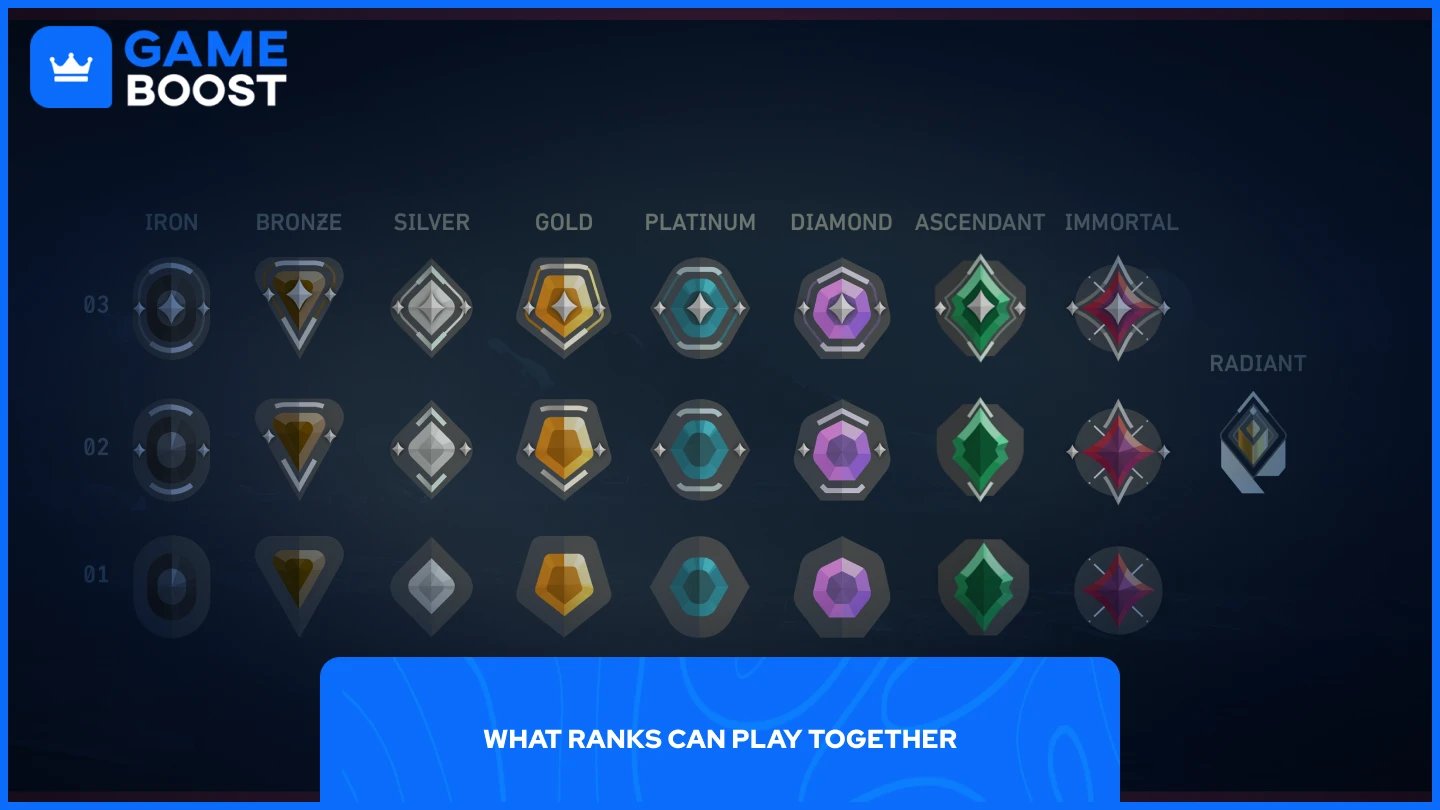
Valorant enforces rank restrictions to maintain fair and balanced matches. These limitations prevent players with significant skill gaps from queuing together in ranked mode. The restrictions apply to parties of two or three players. The table below shows exactly which ranks can queue together based on the highest-ranked player in your party:
Lowest Rank in Party | Highest Rank in Party |
|---|---|
Iron and Bronze | Silver |
Silver | Gold |
Gold | Platinum |
Platinum, Diamond, Ascendant, Immortal, and Radiant | Exactly 1 tier higher max (Example: Platinum 2 can queue with up to Diamond 2) |
For players in Platinum and above, you can only queue with teammates one full rank above or below your current position. A Diamond 1 player can queue with anyone in Platinum (Platinum 1, 2, or 3), all Diamond ranks, and up to Ascendant 1. Players looking to close a rank gap can also look at Valorant boosting on GameBoost.
Also Read: 5 Most Expensive Skins in Valorant
Full parties of 5 players have no ranked restrictions. You can queue with 4 friends regardless of skill level differences. A team with 3 Bronze players and 2 Diamonds can play together as long as all 5 queue up at the same time.
However, playing outside the normal party restriction ranges comes with Rank Rating penalties:
If everyone in your 5-stack group is Ascendant 3 or below, the team will receive a 25% RR reduction if any players are ranked outside of normal party restriction ranges.
If one or more members of your 5-stack group are Immortal 1 to Immortal 3, the team will receive a 25% RR reduction penalty.
If one or more of your 5-stack group are Radiant, the team will receive a 75% RR reduction. Having any players in your group that are below Radiant automatically reduces your potential RR by 90%.
These penalties only affect RR gains, not losses. If you win a match that would normally give you 20 RR, you'll receive 15 RR with a 25% penalty or 5 RR with a 75% penalty. Losing a match still costs the full amount regardless of your party composition.
Also Read: Can You Play Valorant on Steam Deck? (Answered)
Valorant's rank restrictions keep competitive matches balanced by limiting which ranks can queue together. Solo, duo, and trio queues must follow strict tier limitations, while five-stacks can play with any rank combination but face RR penalties for large skill gaps. Understanding these rules helps you plan your ranked sessions and avoid the frustrating "party restricted" message when trying to play with friends. Players queueing as a pair can also pick a name for your duo.
Valorant Accounts For Sale
Buy Valorant Points
Valorant Boosting Service
View all GameBoost Accounts
View all GameBoost Boosting Services
View all GameBoost Currencies
View all GameBoost Game Keys
View all GameBoost Gift Cards
View all GameBoost Items
View all GameBoost Top Ups
Counter-Strike 2 Skins
“ Mustafa Atteya has been writing about gaming and esports since 2023, specializing in competitive game content and player improvement guides. At 25, he brings both hands-on gaming experience and professional SEO writing expertise to the GameBoost team.”