


•Hamza Rashid• 10 min read
League of Legends

League of Legends champions go through balance adjustments regularly, but what happened with Mel was different. After launching in January 2025 as part of the Arcane collaboration, she became the most banned champion across every rank, hitting ban rates above 50% while her win rate sat around 45%. Players didn't ban her because she was overpowered; they banned her because playing against her felt terrible. Riot's solution arrived on February 4, 2026, with patch 26.3 bringing sweeping changes to her entire kit.
This guide breaks down what changed, how her abilities function now compared to before, and what these adjustments mean for gameplay.
The core issue with Mel in League of Legends wasn't her power; she lost more games than she won, sitting at 40-46% win rate, yet players banned her anyway. This disconnect signaled something deeper than simple number tuning could fix. The champion created situations where opponents felt helpless regardless of the match outcome.
The main culprit was her W (Rebuttal), which provided complete damage immunity. Champions like Fizz could land their ultimate perfectly, only to watch Mel press W at the last second and negate everything. Projectile-based champions became nearly unplayable against her, forcing bans from anyone who relied on skillshots.
Riot acknowledged the miscalculation in their official patch notes, saying: "Frankly, we underestimated how frustrating the play-against experience for Mel would be and are aiming to improve that with this change list." The design philosophy was clear: create counterplay opportunities without destroying what made Mel unique. Players needed to feel like skill mattered on both sides, not just whoever picked the champion first.
Mel’s rework in Patch 26.3 targeted three goals. First, opponents needed clear windows to punish mistakes. Second, Mel's abilities required better visual clarity so players could actually see and dodge long-range poke. Third, she should feel rewarded for landing abilities accurately instead of spamming from safe distances.

Before patch 26.3, Mel had an attack speed ratio of 0.4, making her basic attacks feel sluggish and unresponsive. This made last-hitting minions and trading autos in lane more difficult compared to other mid-lane champions.
Mel's passive marked enemies with Overwhelm stacks when her projectiles hit them. Each basic attack after casting an ability fired three projectiles, dealing 8-50 base damage (scaling with level) plus 5% AP per projectile. Total damage from all three projectiles reached 24-150 base damage plus 15% AP per empowered attack.
These projectiles were difficult to see coming at longer ranges. Passive marks appeared on all targets, including minions, creating visual clutter that made tracking important information during fights harder. Enemy players saw Overwhelm marks on every unit Mel hit, cluttering their screen unnecessarily.
Radiant Volley channeled for 0.75 seconds before releasing multiple explosive projectiles. The ability dealt 78/109/144/185/230 total damage with 51-85% AP scaling, and subsequent explosions dealt full damage repeatedly without diminishing returns.
Projectile speed was 4500, making it incredibly fast and difficult to dodge at maximum range. The explosion radius of this Mel’s ability before rework was 230 units with an area spread of 30, covering massive zones. The cast time was only 0.25 seconds, giving opponents minimal time to react.
Against minions, Radiant Volley only dealt 75% damage, making the wave clear inefficient. Mana cost scaled from 70 to 110, forcing careful resource management throughout the laning phase. The ability functioned as standard ability damage, making it effective for resetting Arcane Comet.
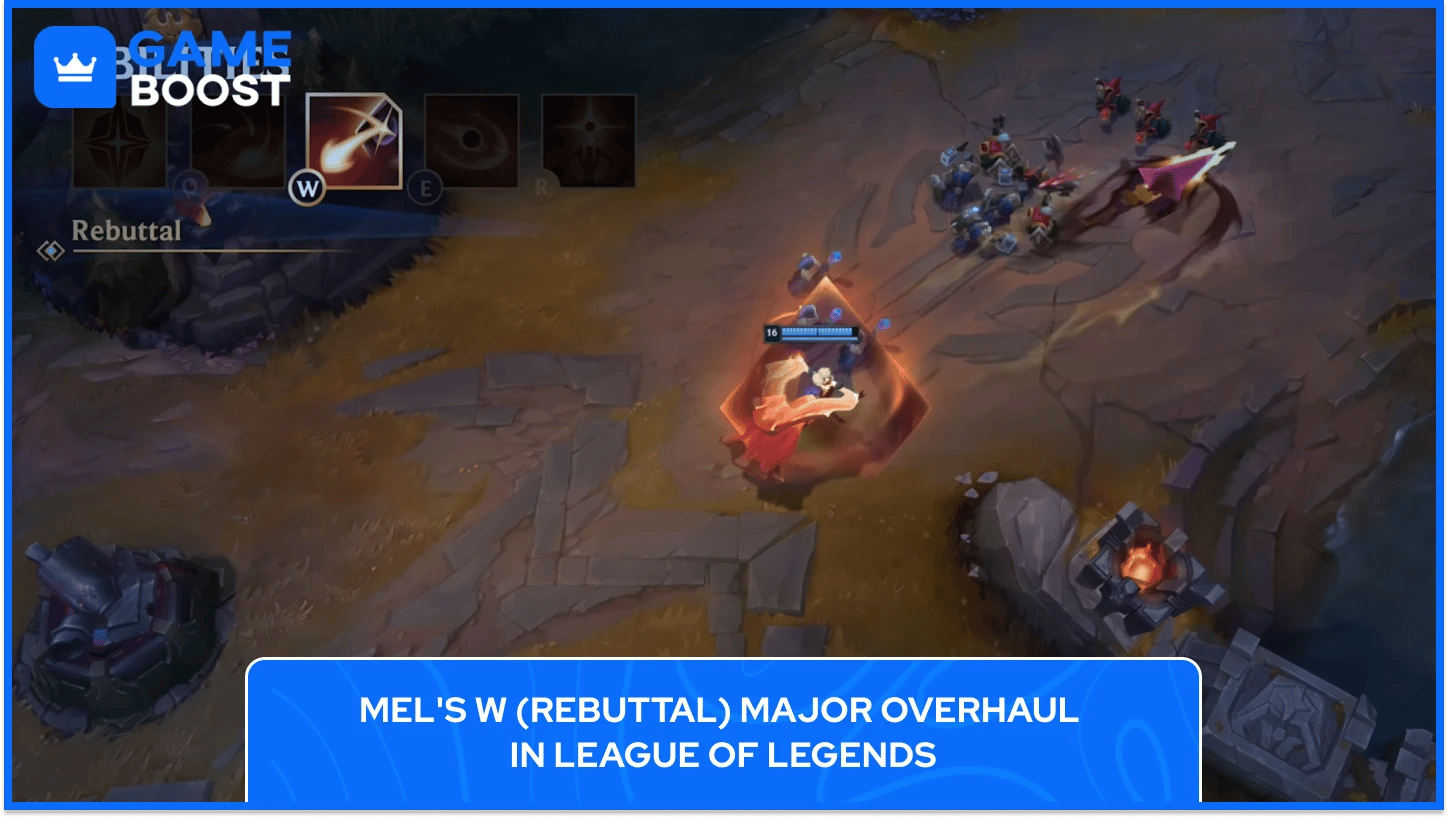
This is Mel’s ability in League of Legends that caused the most frustration. Rebuttal provided complete damage immunity while reflecting projectiles at casters. When activated, Mel became untouchable for a brief window, negating any damage that would have hit her regardless of timing.
The reflection mechanic worked on nearly everything. Single-target projectiles like Jinx's ultimate bounced straight back at full power. Area abilities like Samira's ultimate, Ryze E, Brand E, Katarina’s ultimate, and Yunara Q were reflected entirely, turning teamfights chaotic. It granted 30% decaying movement speed over 0.75 seconds.
Physical damage got converted to magic damage when reflected at full value before conversion. This meant armor didn't help against your own abilities coming back, creating situations where building defensively made you more vulnerable to your own damage.
Also Read: How to Use WASD and Other Hotkeys in League of Legends?
Mel’s ability, Solar Snare, fired a root projectile with an 80-unit radius traveling at 1000 speed. When it reached maximum range or hit terrain, it lingered for 0.5 seconds before creating a damage-over-time field. The DoT radius was 260 units, covering a significant space around the impact point.
Root duration scaled from 1.1 to 1.5 seconds based on rank, meaning early ranks provided minimal lockdown. Base damage ranged from 60 to 220, with damage-per-second ticks of 16 to 56. Cast range was 1050 units, allowing Mel to lock down targets from extreme distances with little counterplay.
Cooldown ranged from 12 to 10 seconds, depending on rank, and the ability visually popped at the end when descending terrain, creating visual inconsistency.
Golden Eclipse unleashed radiant blasts on all enemies marked with Overwhelm. Damage per Overwhelm stack was 4/7/10 plus 3.5% AP. The ability had a global range and revealed targets for 1 second, meaning Mel could execute low-health enemies from across the map without vision.
It required at least one enemy champion affected by Overwhelm to cast. Cooldown started at 120 seconds at rank 1, dropping to 80 seconds at max rank. Cast time was 0.75 seconds with a 100 mana cost. Targets didn't need to be visible for the ability to hit them, creating frustrating scenarios where Mel eliminated targets through the fog of war.
Also Read: How to Counter Zaahen in League of Legends?
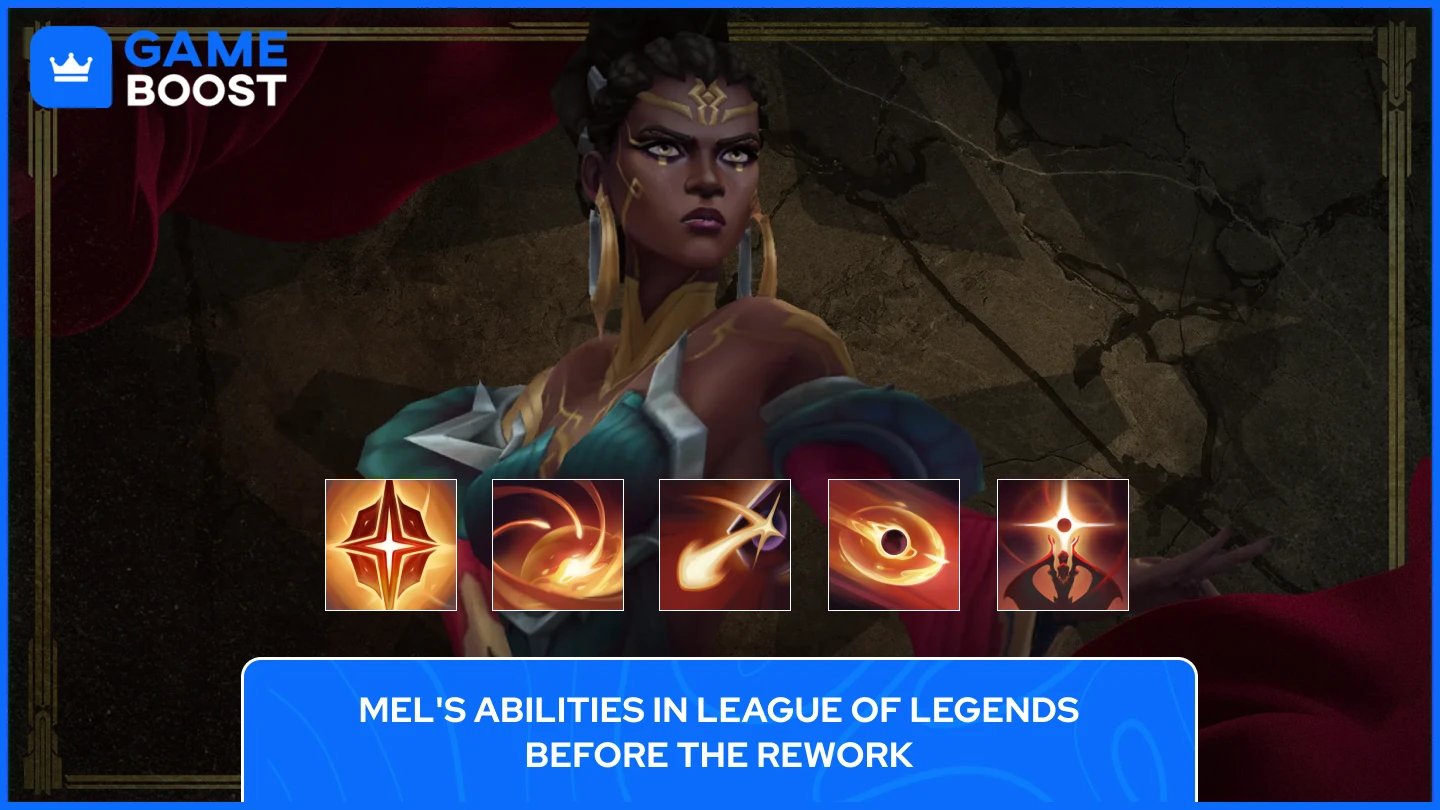
After Mel’s Rework in League of Legends, the projectile damage from her passive dropped from 8-50 to 8-25 base damage, cutting roughly half the scaling by level 18. Also, the AP ratio decreased from 5% to 3% per projectile in Mel's reworked kit. Total damage Mel can deal with her passive now caps at 24-75 base damage plus 9% AP instead of the previous 24-150 plus 15% AP.
The most important change to Mel's passive in League of Legends is the visual clarity improvement. Her Overwhelm passive marks no longer appear on non-champion targets for enemies. This cleans up visual clutter significantly during teamfights. Mel still sees all marks on her screen, but enemies only see Overwhelm marks on champions they need to worry about.
Riot also fixed a bug where certain champion-spawned units died instantly to Mel's Overwhelm from basic attacks. However, the attack speed ratio of her base stats increased from 0.4 to 0.625 in the rework, giving Mel more responsive auto-attacks for last-hitting minions and trading in lane.
The damage structure for Mel's Q completely changed in League of Legends patch 26.3. Q now deals 60/90/120/150/180 base damage plus 60% AP on first hit, with subsequent explosions dealing only 5/6/7/8/9 plus 5% AP. Total damage ranges from 85 at rank 1 to 261 at rank 5, accounting for all explosions hitting the same target.
Projectile speed decreased from 4500 to 3800 in Mel's rework, making Radiant Volley easier to sidestep at long range. The smaller hitboxes compound this change, and the explosion radius shrunk from 230 to 200 units, with area spread dropping from 30 to 25. These adjustments give opponents more opportunities to dodge, but Mel players benefit from faster channel time of 0.5 seconds (down from 0.75), letting her get abilities off quicker in critical moments.
The mana economy improved during Mel’s rework in LoL as well. Costs dropped from 70/80/90/100/110 to 70/75/80/85/90 across all ranks, allowing more frequent ability use during the laning phase. Minion damage increased from 75% to 100%, substantially improving Mel's wave clear. The tradeoff comes from a slightly longer cast time of 0.35 seconds (up from 0.25), giving opponents better telegraphing and reaction windows.
The ability now counts as DoT AoE damage, reducing effectiveness for resetting Arcane Comet. Visual telegraphs became stronger in Mel's reworked kit, showing opponents exactly where explosions will land even at maximum range.
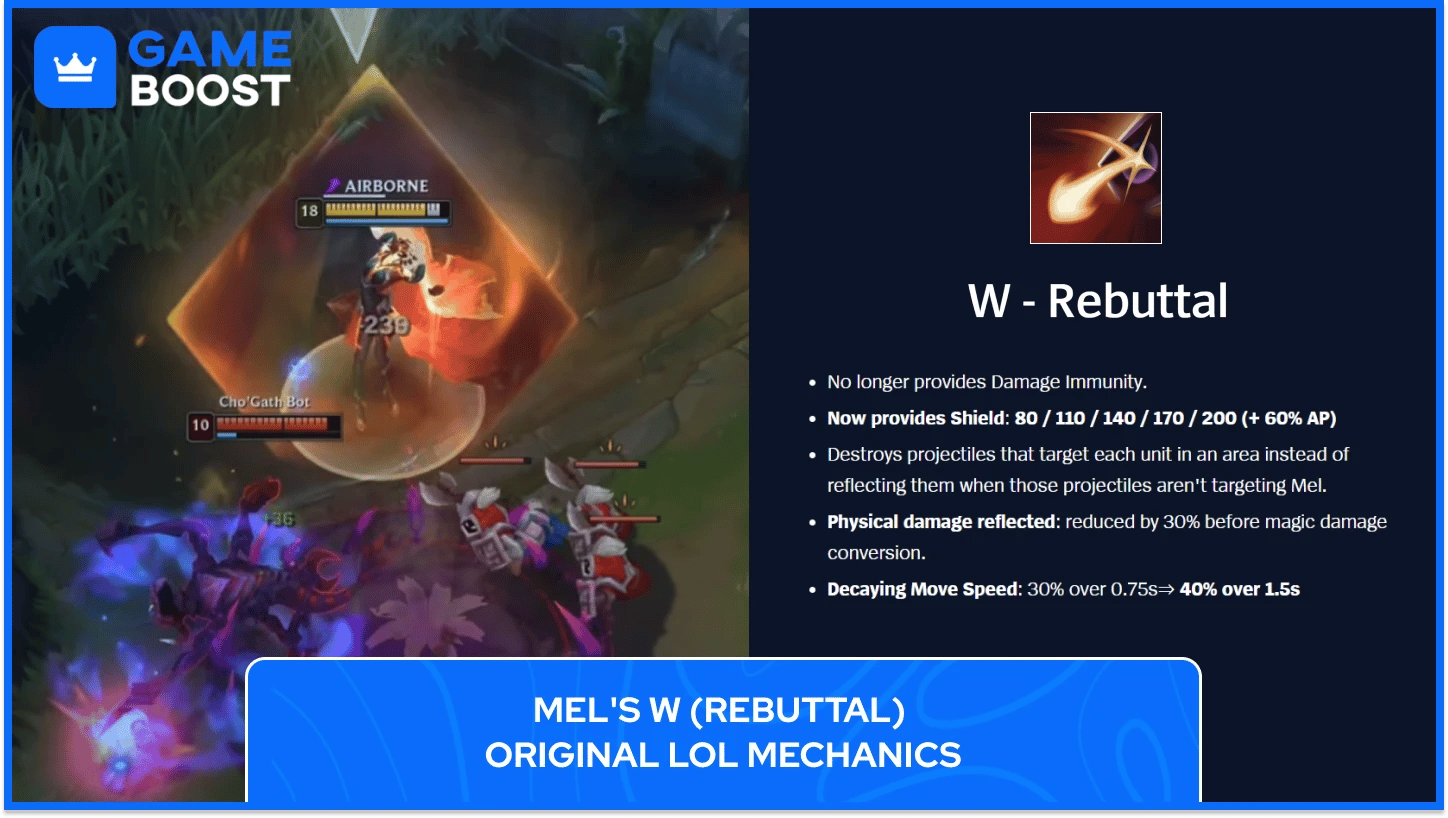
Damage immunity is completely gone from Mel's W after the rework. Instead, Rebuttal now provides a shield of 80/110/140/170/200 plus 60% AP. This fundamentally changes how the ability works, as enemies can now burst through Mel’s shield with enough damage, creating real punishment windows for mistimed uses.
Physical damage reflected gets reduced by 30% before magic conversion in Mel's reworked ability. Area projectiles that hit multiple targets simultaneously now get destroyed instead of reflected.
Movement speed got increased during Mel’s rework to 40%, decaying over 1.5 seconds instead of 30% over 0.75 seconds. The longer duration and higher peak value help Mel reposition more effectively after using W defensively in League of Legends.
The shield scales with AP, rewarding Mel players who build properly. Well-timed burst combinations can now blow through the shield and kill her, especially from champions like Fizz, Syndra, or Veigar who stack damage quickly.
Root missile radius decreased from 80 to 70 units in Mel's League of Legends rework, making it harder to land on moving targets. End-of-travel linger duration dropped from 0.5 to 0.25 seconds, giving opponents less time to accidentally walk into the snare, with DoT radius being shrunk from 260 to 230 units.
After the rework cast range decreased from 1050 to 1000 units, forcing Mel closer to fights to land roots. This provided more risk, but the projectile speed increased from 1000 to 1100 to compensate, making Solar Snare travel faster even with smaller hitboxes. Cooldown improved from 12/11.5/11/10.5/10 to 11/10.5/10/9.5/9 seconds, allowing more frequent use in extended fights.
The reward for landing the ability increased significantly. Root duration is now flat 1.5 seconds at all ranks instead of scaling from 1.1 to 1.5, meaning early ranks provide much stronger lockdown. Base damage after Mel’s reword increased from 60/100/140/180/220 to 60/105/150/195/240, with damage-per-second ticks rising from 16/26/36/46/56 to 16/28/40/52/64. These changes create a clear high-risk, high-reward pattern for Mel's E in the rework.
The ability no longer visually pops when descending terrain. Landing Solar Snare now rewards Mel with stronger lockdown and damage, but opponents have clearer opportunities to dodge it in the rework.
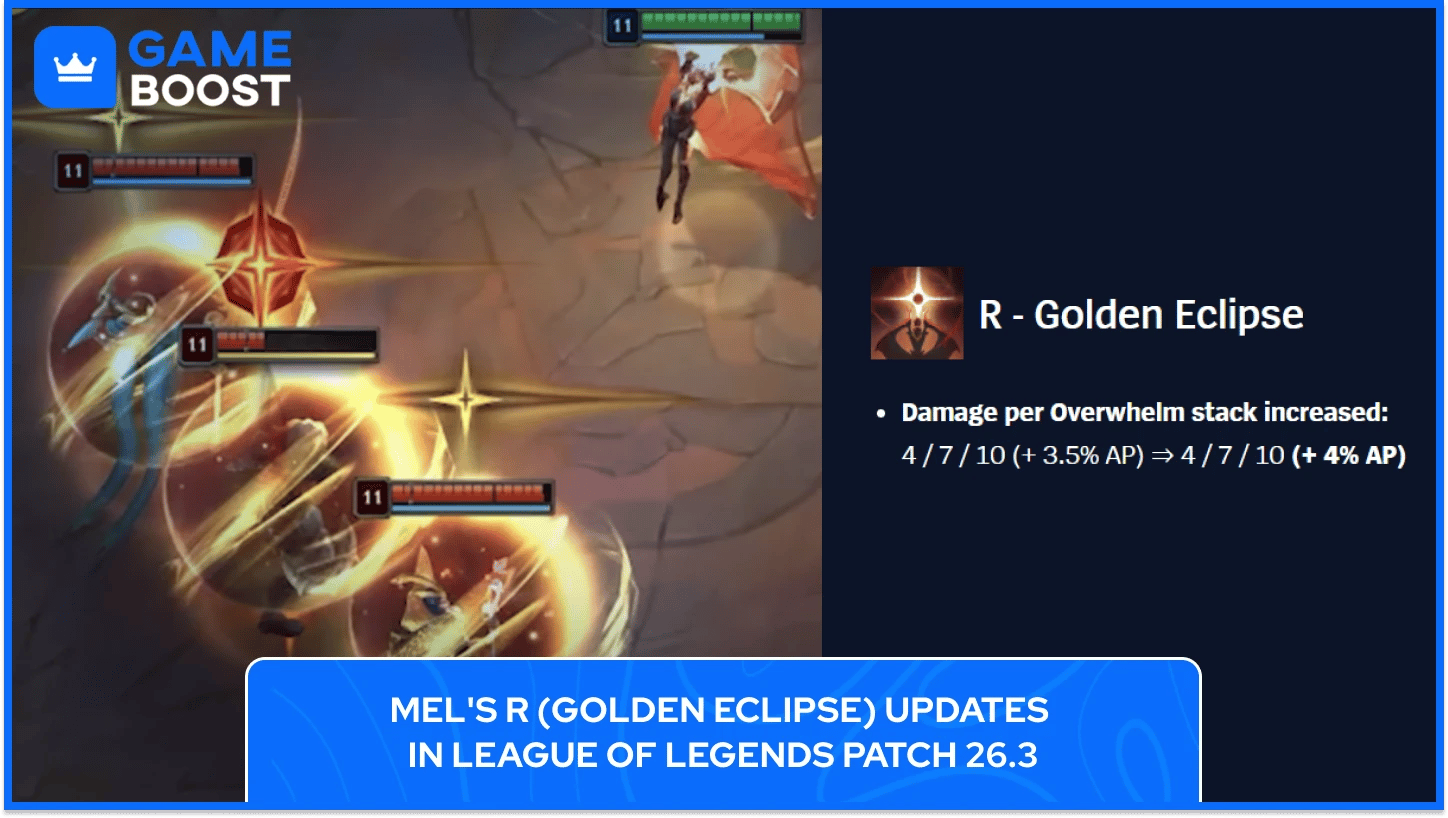
Damage per Overwhelm stack increased from 4/7/10 plus 3.5% AP to 4/7/10 plus 4% AP in Mel's new rework. This small buff helps maintain damage output despite nerfs across the rest of her League of Legends kit. The ultimate still requires at least one enemy champion marked with Overwhelm to cast.
All other stats remain the same: 120/100/80 second cooldown, 100 mana cost, 0.75 second cast time, and global range. Golden Eclipse still reveals targets for 1 second during cast. Enemies don't need to be visible for Mel's ultimate to hit them
Also Read: League of Legends Clash Schedule
Mel's rework in patch 26.3 addressed the frustration that made her the most-banned champion in League of Legends. The changes removed damage immunity from her W, adjusted her damage output across all abilities, and gave opponents clearer ways to fight back. Her ban rate dropped significantly after the update went live, showing that the rework achieved its goal.
The community response has been mixed but mostly positive. Mel mains needed time to adjust to the new playstyle, while opponents appreciated finally having counterplay options. Whether you play as Mel or against her, understanding these changes helps you make better decisions in your ranked games. The rework proves that sometimes fixing a champion means changing how their abilities work, not just adjusting numbers.
Buy LoL Skins
Buy Riot Points
League of Legends Boosting Service
LoL Accounts
View all GameBoost Accounts
View all GameBoost Boosting Services
View all GameBoost Currencies
View all GameBoost Game Keys
View all GameBoost Gift Cards
View all GameBoost Top Ups
View all GameBoost Items
Counter-Strike 2 Skins
“ Kristina joined GameBoost in 2024 as an SEO specialist and quickly became the go-to writer for third-person shooter and competitive games. She covers titles like Fortnite, Valorant, League of Legends, GTA 5, and Roblox, focusing on how-to guides, practical tips, and updates.”