


•Hamza Rashid• 10 min read
Raid Shadow Legends

Uugo, Firrol, Skull Lord Var-Gall, and Krisk the Ageless form the backbone of a strong Raid Hydra team in Raid Shadow Legends. Uugo and Firrol shut down head buffs with Block Buffs, Firrol adds Perfect Veil against Torment, Skull Lord Var-Gall keeps the Head of Decay under Provoke, and Krisk soaks up buff theft from Mischief.
The last two slots go to Geomancer for HP Burn against Blight and a heavy hitter like Royal Guard or Husk to free devoured champions and punish exposed heads. A lineup with those roles covers every head the monthly rotation can throw at a team, including the two substitutes. Head mechanics, role picks with budget alternatives, a three-team roster plan, and battle habits for bigger scores all follow.
A Raid Hydra team runs 6 champions against 4 heads at once, drawn from a pool of six heads
Each champion fights in only one Hydra battle per week, so players need three separate lineups for 3 Hydra Keys
A devoured champion returns only if the team damages the head holding them before a 5-turn digestion ends
Exposed Necks take 200% damage, which makes every decapitation the strongest scoring window in the fight
The Head of Decay is the only head that accepts Provoke, and HP Burn cancels Poison Cloud from Blight
Core picks include Uugo and Firrol for Block Buffs, Skull Lord Var-Gall for Provoke, Krisk the Ageless as a Mischief target, and Royal Guard or Husk for damage
Spreading multi-role champions evenly across all three teams keeps every key productive
Manual targeting, saved cooldowns, and controlled hits on Wrath raise scores more than any single champion swap
Buy Raid: Shadow Legends Accounts
The Hydra is a clan-only boss on the Clan Bosses map, and every member's damage drains one shared HP pool. Survival time decides how much damage each run adds, so lineups built purely for burst rarely post good scores.
Every Hydra lineup works within a fixed set of rules.
Rule | Detail |
|---|---|
Entry requirement | Level 45 and clan membership |
Team size | 6 champions |
Heads in battle | 4 at once, from a pool of 6 |
Weekly keys | 3 Hydra Keys per player |
Champion use | One Hydra battle per champion per week |
Difficulties | Normal, Hard, Brutal, Nightmare |
Weekly reset | Wednesday, between 08:00 and 13:00 UTC |
Clan defeat bonus | Two Hydra Chests per contributing member |
A player's best six champions can fill only one of the three runs, so Hydra scores depend on roster depth far more than Clan Boss teams do. Players without depth end up wasting two keys on underbuilt lineups.
Clans open each new difficulty by fully depleting the Hydra HP on the tier before it. Free Regroup from the pause menu restarts a battle without spending a key or locking champions, which makes it the safest way to test a lineup before a real run.
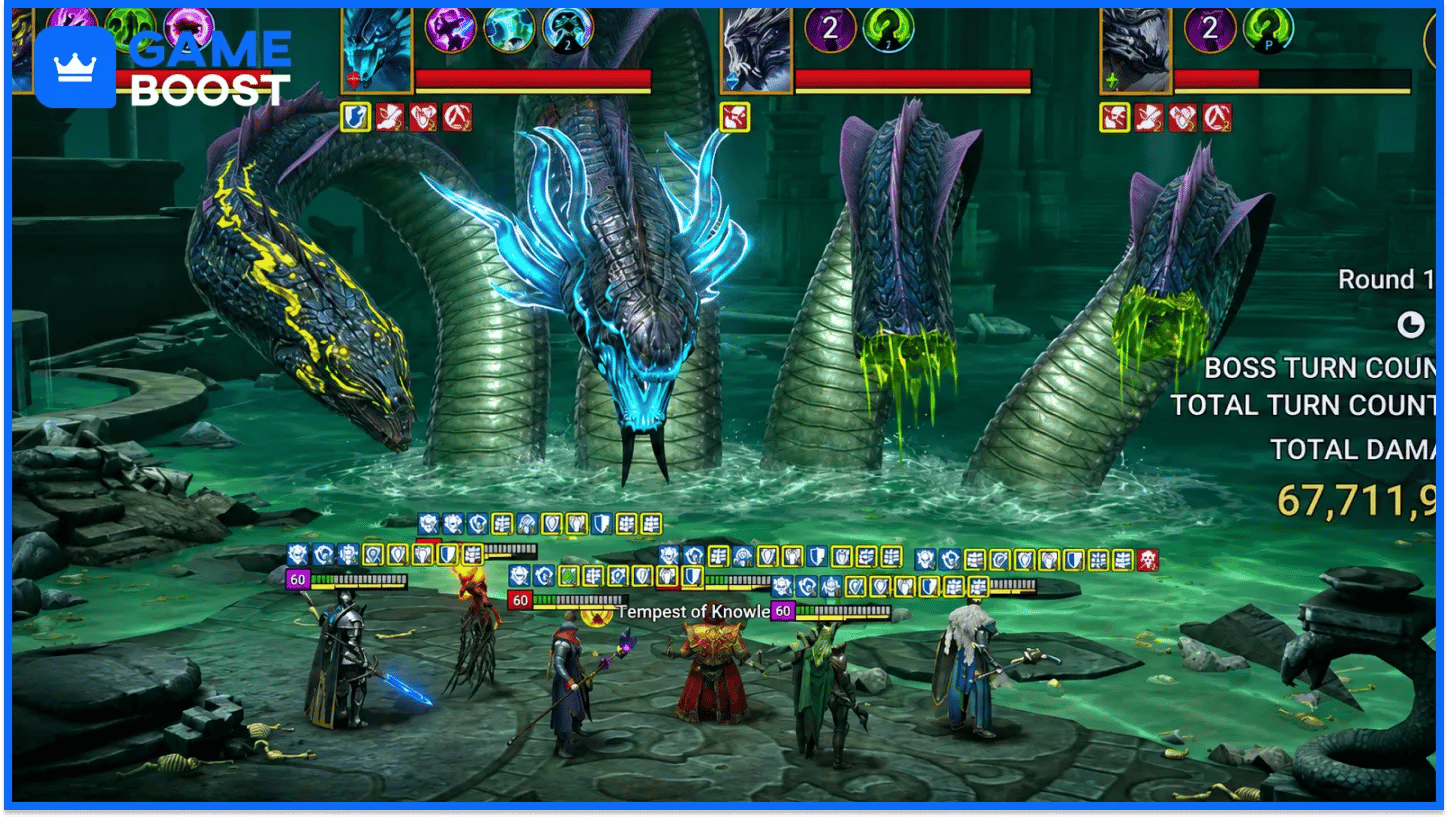
Devouring and decapitation decide most Hydra runs. Devouring can remove a champion for the whole battle, and decapitation creates the biggest damage window in the fight. At the start of battle, one champion receives the Mark of the Hydra with a 20-turn timer, and the next head to act devours that champion once the timer runs out. Every new mark cuts the countdown by one turn, down to a floor of 2 turns, so devours come faster as the fight goes on.
A swallowed champion then sits through a 5-turn digestion countdown inside the head. Enough damage on that head frees the champion, and a failed rescue keeps the champion out of the fight with no revive available. Teams without a hard hitter cannot pull champions back in time, and every lost champion shortens the run.
A head that hits zero HP turns into an Exposed Neck that cannot act and takes double damage from every hit. A new head grows back after 2 turns under Serpent's Will, a buff that cuts incoming damage heavily until the head takes its first turn, so big skills belong on the neck and never on the fresh head. Higher difficulties raise the odds of a substitute head growing back in place of the original. Teams that only cover the starter heads tend to stall the moment an unplanned head appears.
The monthly rotation picks four starter heads and two substitutes, gives each one an affinity, and keeps that setup for every battle until the next rotation. Every head pressures a team in a different way, and a gap in coverage against any one of them can end a run early.
Each head brings a signature mechanic and a specific threat.
Hydra Head | Signature Mechanic | Threat to the Team |
|---|---|---|
Head of Torment | Fear that ignores RES, plus True Fear on champions attacking without Perfect Veil | Locked skills and stalled damage turns |
Head of Decay | Heal Reduction, Life Barrier on the weakest head, and a cleanse on all heads | Healing shrinks MAX HP and planned decapitations fall through |
Head of Blight | Stacked Poison and Leech on the team, Poison Cloud on the heads | Poison stops dealing damage and attacks land as Weak Hits |
Head of Suffering | Unresistable Weaken, Pain Link, Ally Protection, and +50 RES for all heads | Debuffs miss more often and AoE damage drops by 30% |
Head of Mischief | Buff and Turn Meter theft from the most buffed champion | Attacks often redirect onto a random head |
Head of Wrath | Vengeance after enough hits, with attacks at 400% damage | A sudden team-wide blast that can end a run |
Decapitation sometimes helps the team beyond the damage window. A severed Head of Torment clears Fear from the team and grants Perfect Veil to two champions, a severed Head of Decay heals the team and restores half of the lost MAX HP, and a severed Head of Mischief empties the Turn Meter of every head.
Affinities change with each rotation, so a champion who performs well one month can face constant Weak Hits the next. Checking the rotation before locking champions saves keys and keeps teams out of bad affinity matchups.
Six slots cannot hold a dedicated counter for every head, so the strongest picks cover two or three roles at once. A champion tier list helps spot multi-role champions already sitting in the vault.
Each role pairs with the head it targets and the champions who fill it best.
Role | Main Target | Champion Picks | What the Role Does |
|---|---|---|---|
Block Buffs | Blight and Mischief | Uugo, Firrol, Venalicia, Esme, Ostrox | Stops Poison Cloud, Reflect Damage, and stolen buffs from landing |
Provoke | Head of Decay | Skull Lord Var-Gall, Soulless, Master Butcher, Jizoh | Blocks every Decay skill except the basic attack |
Perfect Veil or cleanse | Head of Torment | Firrol, Pheidi | Lets champions attack Torment without gaining True Fear |
HP Burn | Head of Blight | Geomancer, Sulfuryion | Cancels Poison Cloud and deals double damage to Blight |
Mischief target | Head of Mischief | Krisk the Ageless | Draws buff theft away from the rest of the team |
Speed control | All heads | Nekmo Thaar, Krisk the Ageless | Gives champions more turns than the heads |
Heavy hitter | Devoured allies and Exposed Necks | Royal Guard, Husk | Deals Enemy MAX HP damage to free swallowed champions fast |
Provoke only works with manual targeting on Decay, since auto mode skips that target. Newer accounts can cover the role with Master Butcher, a Rare champion, or Jizoh, whom players receive early in the game. The Affinitybreaker set from Doom Tower bosses offers a second answer to Blight by getting around the forced Weak Hits.
Healing needs care in Decay rotations, where every heal trims MAX HP. Shields, Strengthen, Ally Protection, and revives keep a team standing without feeding that passive, and Accuracy sets with Increase ACC buffs help debuffers land through the higher RES on Brutal and Nightmare.
The champion lock turns the Hydra into a roster test as much as a gear test. Three solid lineups beat one perfect team backed by two weak ones, since every key counts toward the same weekly damage total.
A simple planning order keeps all three keys productive.
Sort the vault by role before building anything: List every Block Buffs, Provoke, Veil, HP Burn, and damage champion first. Missing roles show up quickly and decide which team needs the most attention.
Give every team an answer to each starter head: All three keys face the same four starter heads for the month, so each lineup needs those counters before covering substitutes.
Split the multi-role champions evenly: Champions like Uugo or Krisk solve two problems at once, and stacking them on one team leaves the other two short.
Keep duplicate copies of core champions: Each copy counts as a separate champion, so a second Uugo or Master Butcher fills the same role on another team.
Accounts short on depth grow fastest through steady summoning. Saving free shards adds bodies to the vault, and the fusion calendar shows which Legendaries players can build toward through events.
Lower difficulties give thinner accounts a safer place to learn head patterns. Practice on Normal or Hard pays off once the clan moves into Brutal or Nightmare, where substitute heads appear far more often.
Skill timing and target choice decide how much of a team's potential damage actually reaches the Hydra, and the long fight length turns every wasted turn into a noticeable score loss.
A handful of habits separate high scores from average ones.
Switch to manual targeting at key moments: Auto mode spreads damage away from a head holding a devoured ally. Manual control during rescues keeps the team focused on the right head.
Hold the biggest nukes for Exposed Necks: Cooldown-heavy skills post their best numbers on a neck, and firing them into a full-health head wastes the window.
Track the mark countdown every round: Knowing which champion goes next lets the team line up burst damage before the devour lands, which shortens the rescue.
Control hits going into the Head of Wrath: Multi-hit single-target skills fill the Vengeance counter quickly, so aiming them at other heads delays the blast.
Ending a broken run early often scores better than limping on. The Result screen lets players save a score or regroup and run the fight again for free.
During a Hydra Clash, the first key spent on each difficulty gets a Clash Points multiplier. Sending the strongest of the three teams into that first run squeezes the most points out of the bonus.
Hydra progress comes from roster depth more than any single pull. Every Block Buffs specialist, Provoker, and Veil support picked up along the way opens another viable lineup, and that depth keeps all three keys productive for months on end.
Players who treat each new champion as a possible Hydra answer end up with clan scores that keep climbing as the roster grows. Anyone looking for a head start on that depth can find ready-built Raid Shadow Legends accounts on GameBoost and jump straight into stronger Hydra rotations.
Raid Shadow Legends Starter Accounts for Sale
Buy Acrizia Accounts
Cheap Raid Shadow Legends Accounts
View all GameBoost Accounts
View all GameBoost Boosting Services
View all GameBoost Currencies
View all GameBoost Game Keys
View all GameBoost Gift Cards
View all GameBoost Top Ups
View all GameBoost Items
“ Hamza is your average video game enthusiast who’s always looking for his next game to play. Whether he’s diving into a competitive multiplayer match, exploring a massive open world, or getting completely hooked on a new release, gaming has always been one of his favorite ways to spend his time. Over the years, his love for games has grown into a passion for understanding and sharing everything about them. Through his articles, Hamza aims to help gamers discover new games, improve their skills, stay up to date with the latest gaming news, and get the most out of their favorite titles.”