
.png)

•Muhammad Nagi• 4 min read
Counter Strike 2
CS2 tournament play reaches its closing day at PGL Major Singapore with a third-place match that runs before the best-of-five grand final.
The CS2 PGL Major Singapore third-place match gives the two losing semifinalists another contest on the closing day. Their championship runs have ended, but a competitive match still settles third or fourth place in the tournament record.
Below, the Pick'ems campaign, the third-place format, the best-of-five series, the Cologne schedule, and the pairing timing each get a clear explanation.
The third-place match runs before the grand final and decides which losing semifinalist finishes third and which finishes fourth.
The best-of-five grand final requires three map wins, and five maps is the maximum length of the series.
Semifinal winners reach the grand final for first and second place, and semifinal losers meet in the third-place match.
The Cologne schedule lists only the grand final on its closing day, and Singapore includes a third-place decider ahead of its championship match.
The third-place pairing comes from the semifinal results, so the match needs no extra qualification round.
Hotspawn's free-to-play CS2 Pick'ems gives away €60 in Steam vouchers on its weekly leaderboard throughout PGL Major Singapore.
Hotspawn’s free-to-play CS2 Pick’ems gives away €60 in Steam vouchers on its weekly leaderboard. It is free to enter, with participants earning points for correct match predictions. Leaderboard scores reset for each new week. The campaign runs through PGL Major Singapore 2026, which concludes on December 13. Its closing day will include a match with a different purpose from the grand final: deciding third place.
Submitted picks can be changed until five minutes before the scheduled start, when they lock. After that deadline, the selection stays fixed while the teams decide the result. Correct picks contribute to the weekly competition, with prizes attached to leaderboard finishes rather than awarded for every successful prediction. Following a fixture also means understanding its role in the tournament.
A semifinal determines who advances to the championship match; the grand final determines the champion. Singapore gives the two losing semifinalists another contest on the closing day for their final position. Their championship runs have ended, but they still have a competitive match to play before their place in the tournament record is settled.
Players compare their scores on a weekly leaderboard, where there are Steam vouchers on the line for qualifying finishers. Prize eligibility requires at least 10 picks. Each selected fixture has its own result to follow. In Singapore’s closing rounds, understanding those results means following both the championship and the third-place contest, since the final day will settle more than the identity of the winning team.
PGL’s April announcement places the third-place decider before the best-of-five grand final on Sunday. The organizer describes the additional fixture as an opportunity for teams to secure a podium finish. That gives the match a defined competitive purpose within the closing day.
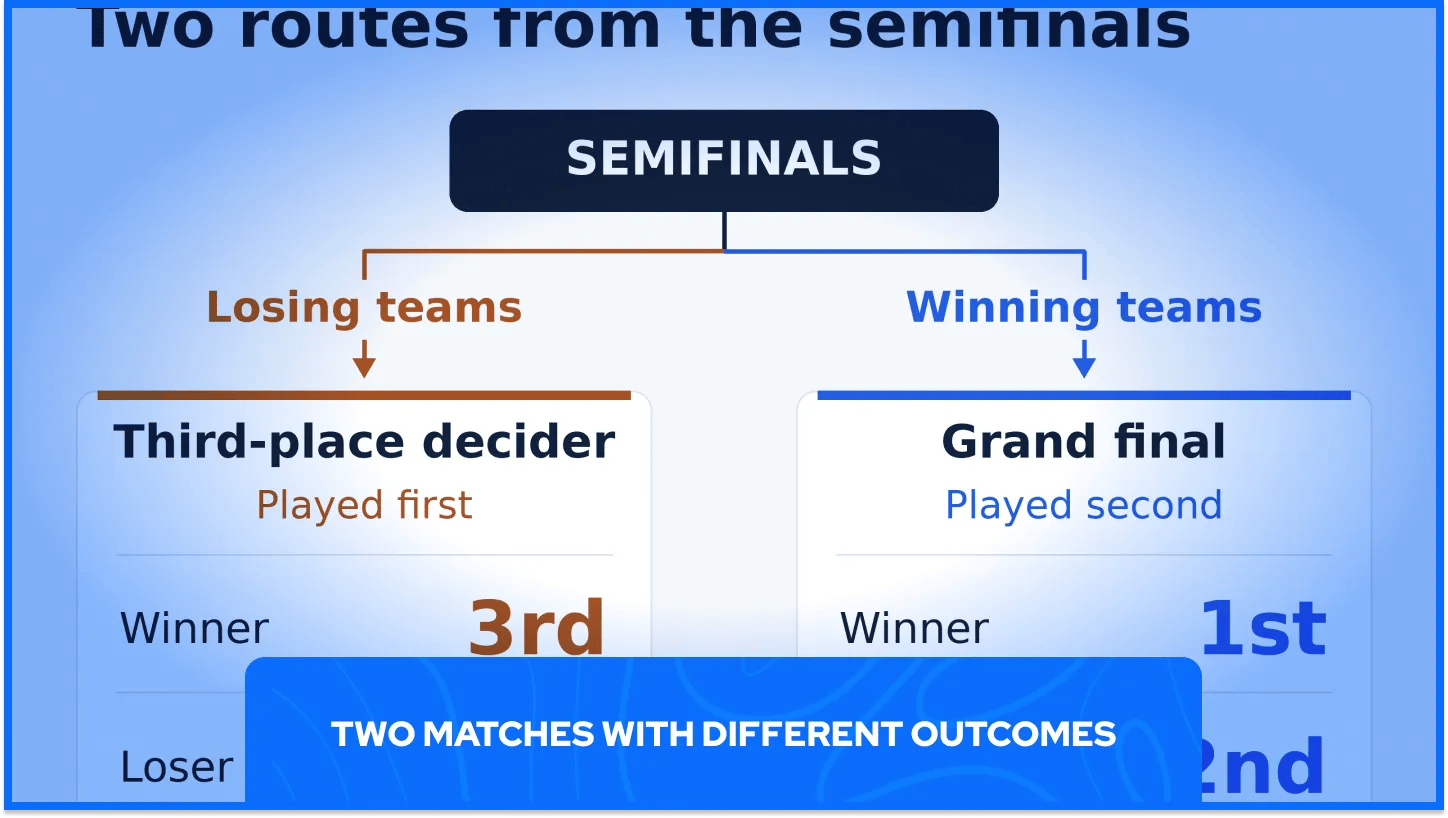
The two routes separate at the semifinals. Winners progress to the grand final, where first and second place are decided. The losing semifinalists meet in the third-place decider, whose winner finishes third and whose loser finishes fourth. Reaching that match therefore means a team has already missed the final, but its finishing position remains unsettled. This is a somewhat unusual setup, so it’s worth taking the time to understand.
The decider uses a direct match result to separate teams eliminated in the same round. Its winner finishes higher, regardless of which semifinal had the closer score. Earlier results explain how each team reached that point; this match supplies the result that separates third from fourth.
Counting from the semifinals, that produces four matches: two semifinals, the third-place decider, and the grand final. Each semifinalist plays twice across those rounds. The first appearance determines which final-day fixture a team reaches; the second determines its final position.
The grand final’s best-of-five format describes a series of maps. A team must win three maps to win the series, and play ends once it reaches that total. Five is the maximum number of maps, rather than a promise that every final will last that long.
The announcement attaches best-of-five specifically to the grand final and leaves the third-place decider’s series length unspecified. It establishes which match comes first, without giving either a start time. The order is confirmed; the precise viewing schedule still depends on the detailed match timetable.
ESL’s Cologne Major announcement set out a four-day arena schedule for June 2026. That schedule placed quarterfinals on June 18 and 19, semifinals on June 20, and the grand final on June 21. The announcement described an eight-team playoff field across four days at LANXESS arena.
That schedule follows the championship bracket toward one remaining fixture. The quarterfinals reduce eight teams to four, and the semifinals select the finalists. Its listed Sunday competition is the grand final. Singapore’s announcement adds a third-place decider ahead of that final-day championship match, retaining a competitive role for the other two semifinalists, and adding potential interest for viewers.
Cologne’s full tournament was scheduled for June 2–21, covering three stages before the playoffs. The arena dates described only the closing portion. Singapore likewise reserves its stadium dates for the last four days, so the third-place decider sits within the finish of a much longer competition.
An extra fixture does not require another round of qualification. The semifinals already identify both pairs needed for Sunday. Their winners take the championship route, while their opponents move into the third-place match. The bracket produces both matchups from the same set of results.
PGL has announced a 32-team event concluding on December 13, with the closing four days at Singapore Indoor Stadium. The tournament field and the third-place pairing are established at different points. The organizer will use the November 2 Valve Regional Standings to determine participating teams, but the decider’s opponents emerge from the semifinals.
The third-place match supplies a result from the tournament itself: a direct contest between the two teams whose title runs ended one round short of the final. Winning that contest does not move a team above the runner-up, whose semifinal victory earned a place in the championship match. Singapore’s Sunday ends with four distinct positions: the champion and runner-up from the grand final, followed by third and fourth from the decider.
Each fixture in the closing rounds carries its own role in the tournament. A semifinal determines who advances to the championship match, the grand final determines the champion, and the third-place match gives the two losing semifinalists a competitive match that fixes their place in the tournament record.
“ Hamza is your average video game enthusiast who’s always looking for his next game to play. Whether he’s diving into a competitive multiplayer match, exploring a massive open world, or getting completely hooked on a new release, gaming has always been one of his favorite ways to spend his time. Over the years, his love for games has grown into a passion for understanding and sharing everything about them. Through his articles, Hamza aims to help gamers discover new games, improve their skills, stay up to date with the latest gaming news, and get the most out of their favorite titles.”