


•Hamza Rashid• 10 min read
League of Legends
League of Legends is one of the most played competitive games, with millions of matches happening every day across all regions. With an extensive enforcement system to keep the experience fair, Riot covers everything from chat behavior and scripting to account sharing and hardware-level violations. For most players, a ban notification comes as a shock, and the first instinct is to look for a way out.
Account bans in LoL range from short temporary suspensions all the way to permanent and hardware-level restrictions, and the path forward depends entirely on which type of ban you're dealing with. This article covers how the ban system works, what your options are for appealing, and what actually determines your chances of getting that account back.
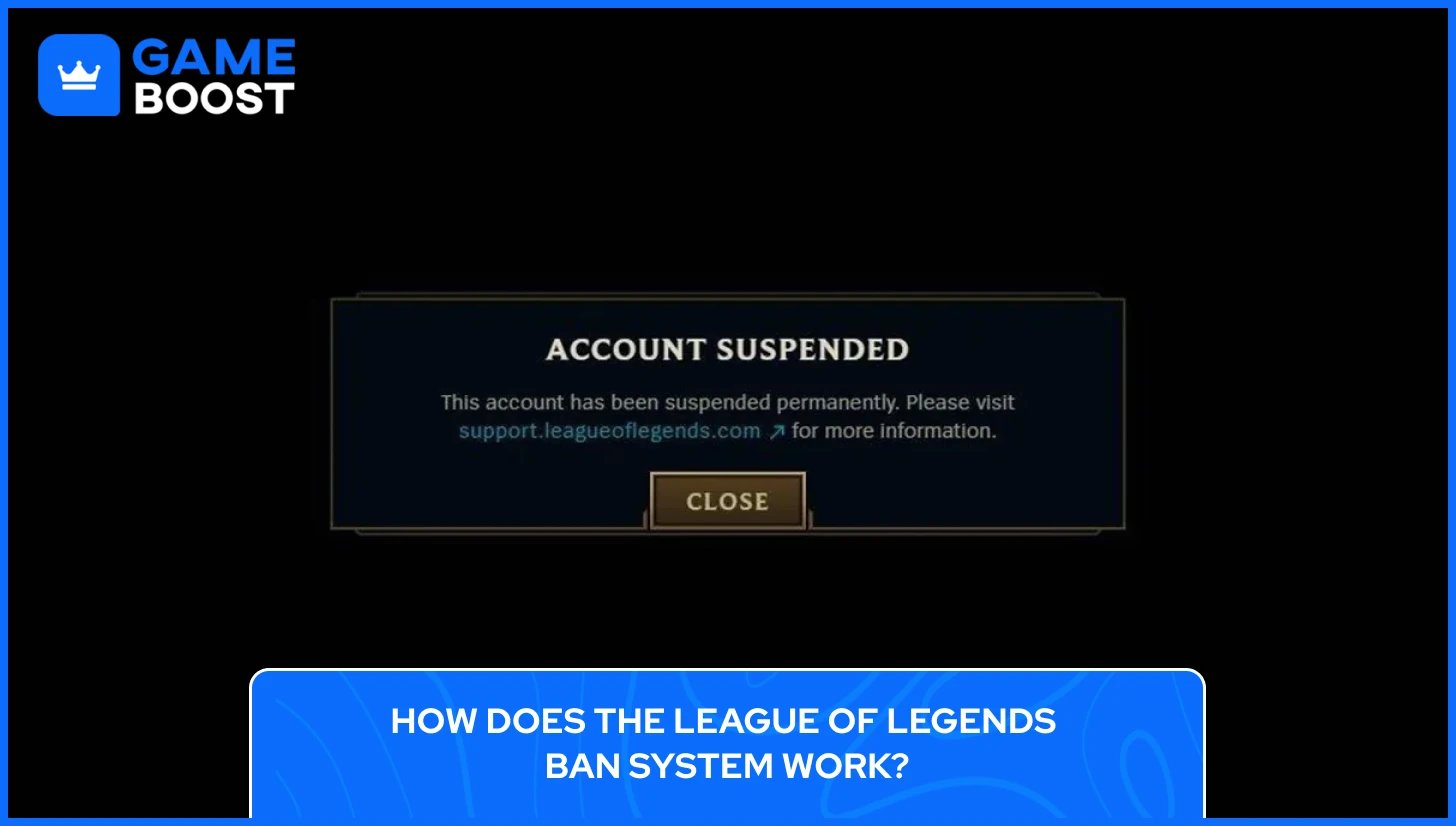
Riot has always been transparent about the fact that their ban system exists to protect the experience for the majority of players, not to give individuals the benefit of the doubt. The enforcement structure in League of Legends is built around two core components working together, one automated and one human, and understanding both helps clarify why some bans stick and others get reversed.
Not all bans carry the same weight. Punishments in League of Legends range from temporary chat restrictions all the way to permanent account suspensions, depending on the severity and frequency of the offense. Riot structures punishments in a clear progression, with each repeated offense carrying heavier consequences than the last.
Here is the League of Legends ban system breakdown:
Offense | Penalty | What It Means |
|---|---|---|
1st Offense | 3-day chat restriction | Communication in-game is limited |
2nd Offense | 7-day chat restriction | Restriction period doubles |
3rd Offense | 14-day ban | Full account access suspended |
4th Offense | Permanent ban | Account suspended indefinitely |
Extreme behavior | Instant permanent ban | No prior warnings issued |
Repeat permabans | ID (HWID) ban | Blocked across all Riot platforms |
Beyond standard account-level bans, there is a more severe category. An ID ban is a rare, drastic step Riot takes against players who have consistently chosen not to abide by the terms of service. When a player is determined to receive an ID ban, it means Riot does not want that particular person to create, access, or use any account on a Riot platform for the duration of the ban. ID bans are extremely uncommon, and to date, only a handful of players globally have ever received one. They represent the most extreme end of Riot's enforcement spectrum, well beyond a standard permaban.

The engine behind most bans in League of Legends is the Instant Feedback System. When a player is reported, their case is first reviewed by the automated Disciplinary System. This system analyzes match data, reads the in-game chat log, and weighs the offending player's report history before determining the appropriate disciplinary action.
The Instant Feedback System is designed to rapidly identify and act upon cases of clear violations. League of Legends Bans are usually issued within 15 minutes of a game's conclusion, although sometimes the punishment appears when you log in the next time.
However, depending on the severity of the report, a player could be permanently banned in League of Legends on their first offense. The system does not always follow the gradual escalation path. Extreme behavior, such as hate speech or direct threats, can skip straight to a permanent ban without prior warnings.
Suspensions and bans from the Instant Feedback System are generally not lifted or adjusted, and correctly placed penalties will not be removed. More serious penalties are almost always preceded by warnings and suspensions, but excessive negative behavior can result in a permanent ban at any time without prior warnings.
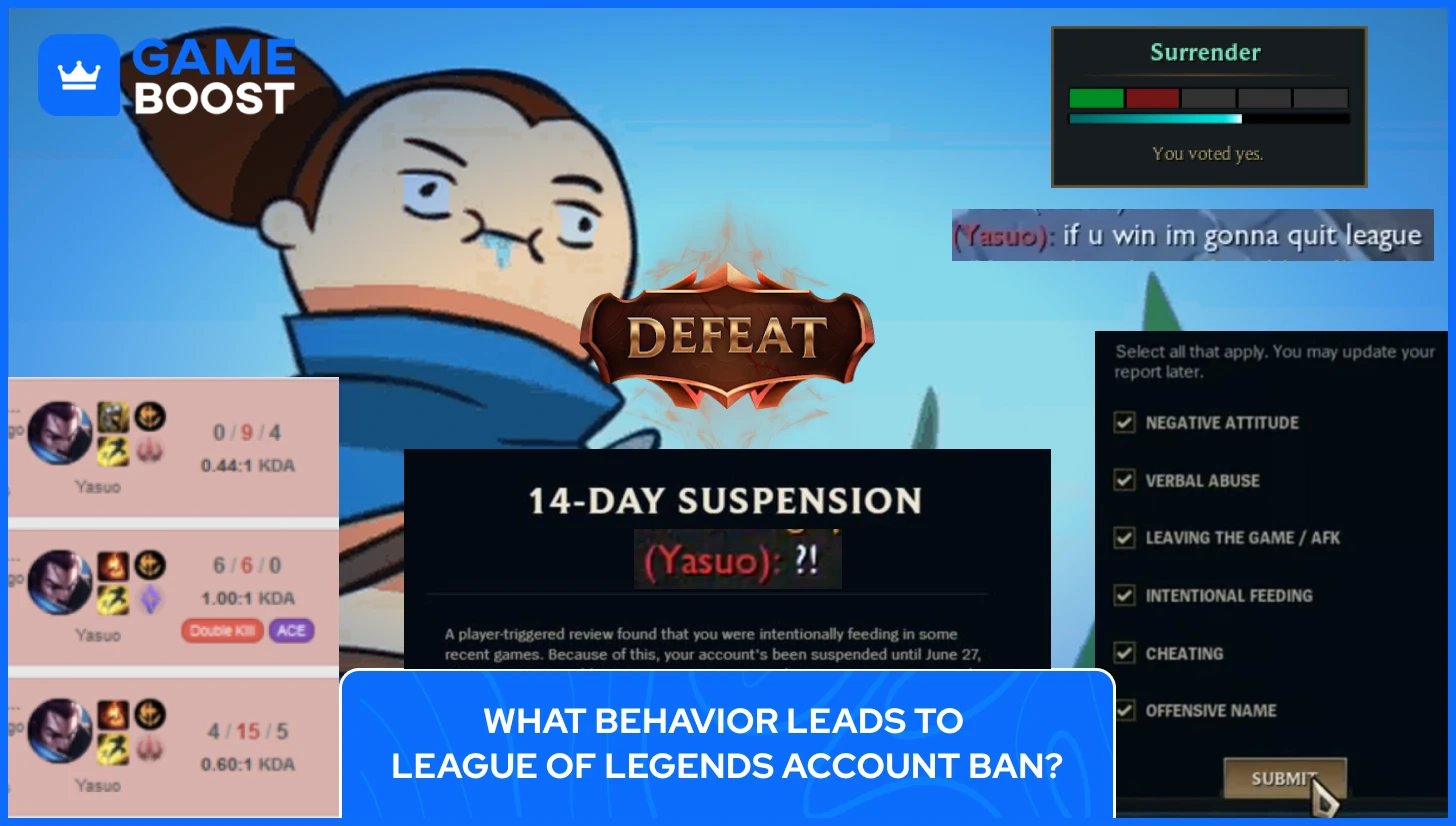
The two most common reasons for bans in LoL are chat toxicity and scripting, with other violations including MMR boosting and gifting abuse also being frequent causes.
Here is are the most common reasons why Riot might Ban your League of Legends Account:
Verbal abuse and hate speech — flaming, harassment, slurs, threats, and any discriminatory language in chat, including Party Chat
Griefing and intentional feeding — deliberately ruining games through in-game actions, playing to lose on purpose, or sabotaging teammates
AFK and leaving matches — repeatedly going AFK or disconnecting mid-game, tracked automatically by the LeaverBuster system
Scripting and third-party software — using any program that automates gameplay or provides an unfair advantage (typically results in an instant permanent ban)
MMR boosting — having a more skilled player play on your account to inflate your rank, or duo queuing with a booster to get carried
Account sharing — allowing anyone else to access your account, even without money involved
Purchased botted accounts — owning accounts that were leveled by bots or bought from third-party sellers
Win-trading — coordinating with opponents to manipulate match outcomes
Intentional deranking — deliberately losing ranked games to lower your MMR
Financial violations — chargebacks, purchasing RP from unauthorized third-party vendors, or fraudulent transactions
As of Patch 25.23, penalties are now linked across all accounts Riot is confident belong to the same player, meaning a ban on one account can automatically carry over to all connected accounts.
Also Read: League of Legends: What is a Smurf Account?
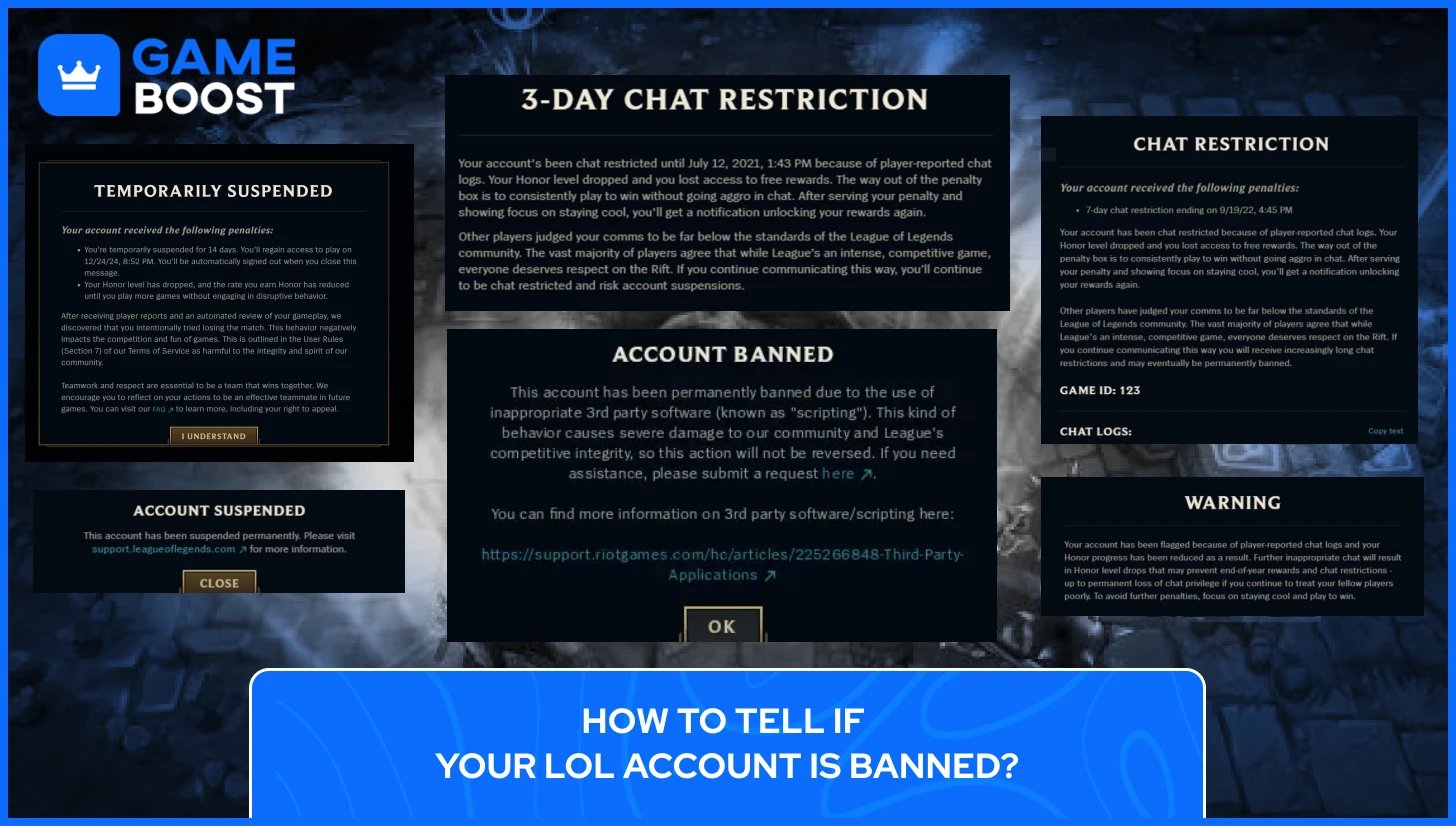
Most players find out about a League of Legnds ban the moment they try to log in. When you log into your account in the League of Legends client, a detailed notification will tell you if you have been banned, point to the reason for the ban, and tell you how long the ban will last.
The notification message varies depending on the type of penalty. For a chat-based suspension, the client typically displays a message along the lines of: "Your account has been suspended until DD/MM/YYYY TIME because of abusive, player-reported comms. Your honor level has dropped, and you lost access to free rewards." The client will then likely pull up a list of your messages in chat so you can see exactly why the ban was issued.
For a permanent ban, the message is more definitive. Players found to be abusive will receive a message stating that a player-triggered review found their in-game communications extremely inflammatory and offensive, resulting in a permanent account suspension.
There are a few other signs that point to a League of Legends account ban or restriction even before the login screen:
Unable to log in at all — the most direct indicator of a ban or suspension
Chat restriction active — you can still play but your ability to communicate in-game is limited
Honor level drop — a visible drop in Honor level often signals a recent penalty
Ranked restrictions — loss of access to ranked queues can accompany certain suspensions
VAN 152 error code — this specific error on login indicates an HWID ban, not a standard account ban
"Suspension" and "ban" are not always used consistently, even by Riot. Suspension most often describes short-term penalties that keep a player out of the game for a set period, while ban typically refers to a permanent restriction. If there is any doubt about the type of penalty, checking the duration in the client is more reliable than relying on the terminology alone.
If the account cannot be accessed at all and no ban message appears, it may have been compromised. In that case, Riot recommends submitting an account recovery request from the login page or contacting Riot Support directly, as proactive suspensions due to suspicious activity vary by case.
Getting unbanned from League of Legends is possible, but the odds depend heavily on why the ban was issued in the first place. Riot maintains that correctly placed penalties will not be removed, but the company does offer a formal review process for players who can demonstrate their account was flagged in error.
Temporary bans end on their own, but harsher League of Legends Bans require a manual review from Riot, and even a well-written appeal is not guaranteed to succeed. The cases with the best chance of reversal are compromised accounts, false positives from the automated system, and mild toxicity bans where context was clearly missed. Hate speech and slurs, on the other hand, are rarely forgiven.
Riot's Player Support will not bargain, shorten, or give a second chance where the evidence of a breach is solid. If the chat logs confirm the violation, no appeal will change the outcome. The process is worth attempting only when there is a genuine case that the ban was applied in error.
Also Read: How to Fix Unknown Player Error in League of Legends
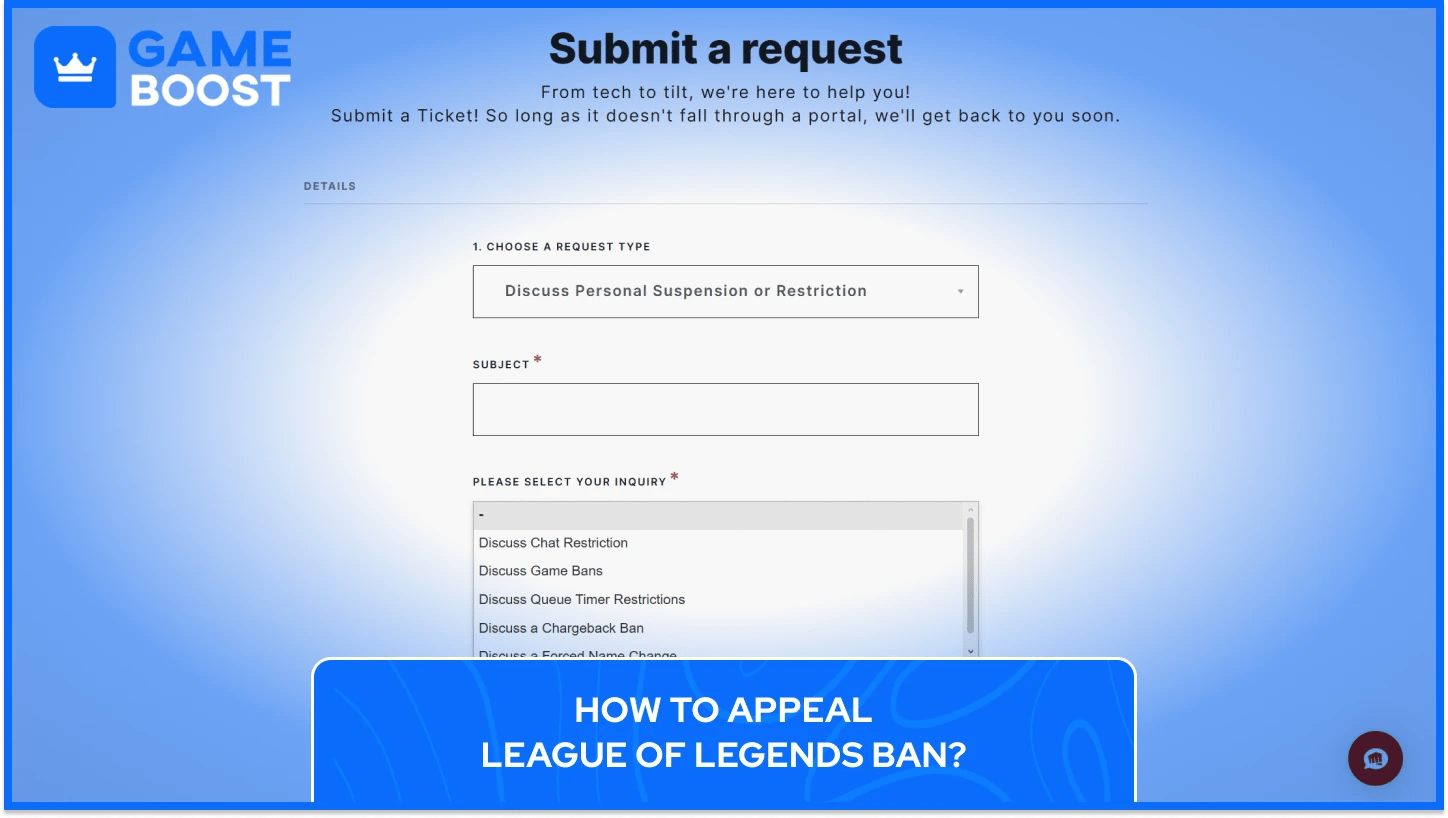
Submitting an appeal is done entirely through Riot's official support page. To appeal, go to the official Riot Support page, log in with your banned League account, and select "Account Management" followed by "Ban or Suspension Appeal".
From there, follow these steps to appeal League of Legends Ban:
Go to support-leagueoflegends.riotgames.com and sign into the banned account
Click "Submit a Ticket"
Select "Discuss a Personal Suspension, Ban, or Restriction" from the dropdown
Choose "Discuss Game Bans" as the inquiry type
For permanent bans, select "31+ days" as the penalty duration; for shorter suspensions, select the matching duration
Write your appeal in the description field
Attach any supporting evidence such as screenshots, chat logs, or account compromise proof
Click "Submit" and wait for a response
The average Riot response time is around 3 business days, though this can be longer near major patches or during ban waves. Simple account-compromise cases can be resolved in as little as 24 hours, while scripting or toxicity cases may take weeks. Check the spam folder after submitting, as Riot's response can occasionally land there.
Opening new requests bumps the original ticket to the back of the queue and can mark the account as a spammer, so its better submit your League of Legends Account ban appeal once and wait.
The content of the League of Legends Ban appeal matters, and equipping the appeal with facts, screenshots, and the right tone gives it the best possible chance of getting it. Sometimes, the difference between a permaban and a restored account is the quality of the argument made.
A strong ban appeal for the League of Legends account should include:
A clear explanation of why the ban was incorrect (specific, not vague)
Chat logs or match data — if context was missed by the automated system
Payment or purchase receipts — for chargeback or gifting-abuse bans, attach the relevant Riot Games Store invoice
Evidence of account security steps taken, two-factor authentication being enabled
Account compromise proof — login attempt emails or security alerts if the account was hacked
Keep the appeal under 1,000 characters if possible, state the ban type, attach the evidence gathered, and explain the circumstances along with what steps have been taken to prevent a repeat offense. Use a respectful tone, as Riot agents can and do reject appeals written otherwise.
Riot Support has access to VODs as well as chat logs, so lying does not work. Admitting to mistakes and showing awareness of what went wrong is far more effective than deflecting blame.
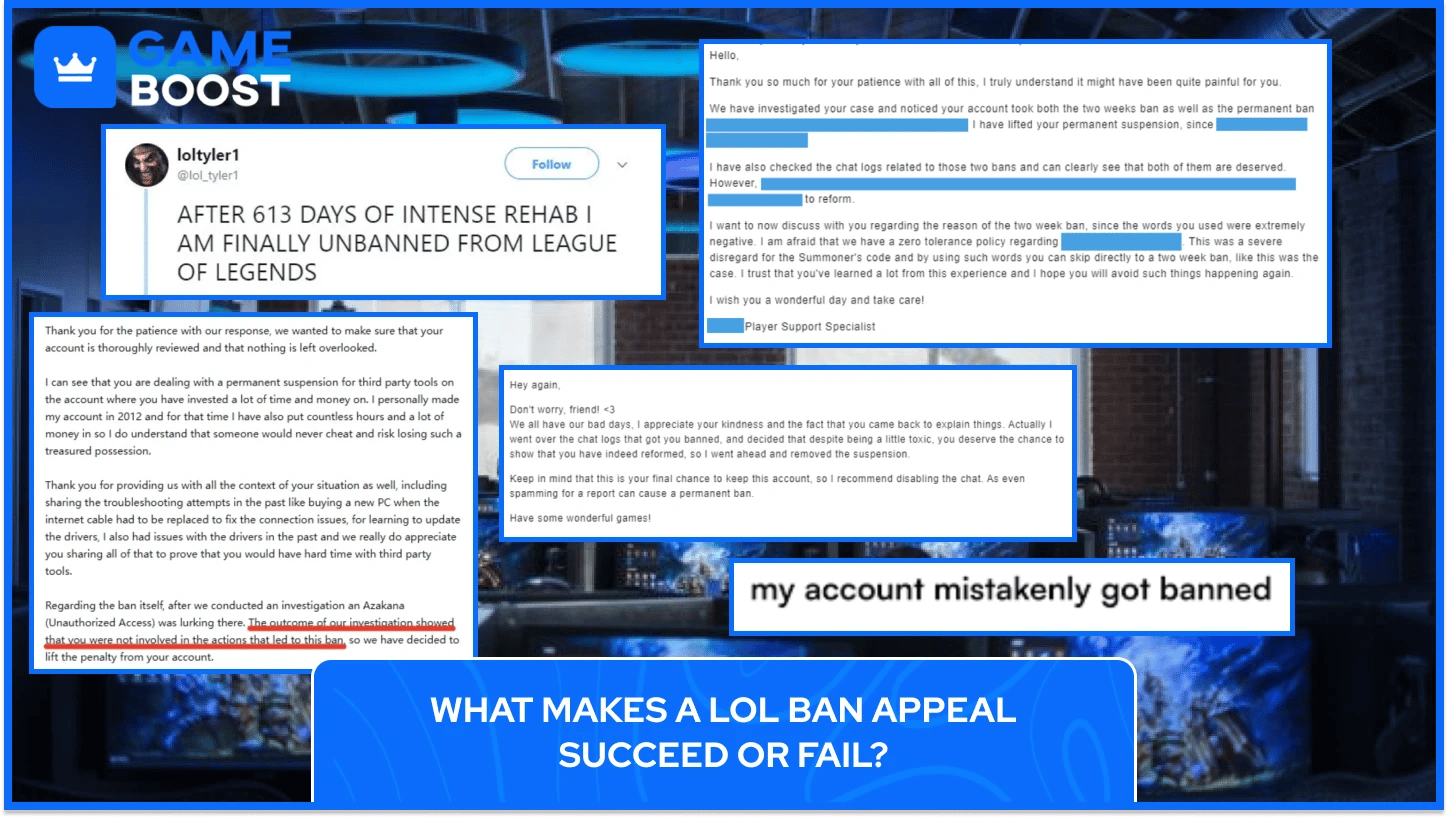
The outcome of a LoL ban appeal comes down to the question if did Riot's system made a mistake. Riot's systems do make genuine mistakes, and a thorough, well-evidenced appeal gives the only realistic shot at reversing the account ban. If the logs confirm wrongdoing, however, no template will undo the sanction.
Appeals for League of Legends ban tend to succeed when:
The account was compromised, and someone else caused the violation
The automated system flagged behavior out of context, such as sarcasm, as harassment
A false positive was triggered by an AFK or intentional feeding detection on a genuinely poor game
A financial dispute was resolved, and the account suspension was precautionary
League of Legends account ban appeals almost always fail when:
The ban followed multiple prior warnings for the same behavior
Hate speech, slurs, or direct threats were involved
Cheating or scripting was detected, as Riot has zero tolerance for third-party software
The account was confirmed to have been shared or boosted
Permanent bans are difficult to reverse, but most temporary bans can be appealed successfully, provided the appeal is civil, takes responsibility for the actions involved, and gives Riot a clear reason to reconsider.
Also Read: How to Uninstall League of Legends?
Most permabans don't come from one bad game. Riot's enforcement builds on a history of repeated behavior, and by the time a permanent ban lands, the account has usually been flagged multiple times before.
A few consistent habits remove the majority of the risk:
Turn off all chat or mute players early — most toxicity bans build across multiple games before Riot acts, and removing chat entirely cuts that risk at the source
Stay in the game even when it's going badly — repeated AFK patterns and deliberate griefing are tracked the same way chat violations are
Never share account credentials or use boosting services — with penalty linking active, any violation on a connected account now carries across to all accounts tied to the same player
Avoid any third-party software — Vanguard flags anything interacting with the client outside of what Riot permits, with no prior warning and no appeal path
Report bugs and exploits rather than using them — exploiting in-game bugs can carry 14-day suspensions or permanent bans
Secure the account with two-factor authentication — a compromised account can generate violations that the original owner had no part in
Also Read: Don't Share Your League of Legends Account for These Reasons

Permanent bans can be overturned, but results vary heavily by offense type and prior account history. Compromised accounts and false positives from the automated system have the best chance of reversal. Bans involving hate speech, scripting, or a long history of repeated violations are almost never lifted, regardless of the appeal quality.
Correctly placed penalties will not be removed, and therefore, permabans are permanent. Continued negative behavior despite prior warnings indicates an unwillingness to change, which is a core reason Riot does not revisit these decisions.
If a player received an HWID ban as a result of negative in-game behavior, it is possible but never guaranteed that the ban will be lifted in the future. The player needs to wait at least one year from the date of the ban before submitting a request for re-evaluation. If the conditions are not satisfied, the ban can be re-evaluated beginning one year from the date of the previous request.
A player banned from one Riot service may also lose access to others, such as Valorant or Teamfight Tactics, including any purchased content or progress made on the account. With penalty linking now active across connected accounts, the consequences of a ban in League of Legends can extend to other games developed by Riot.
Riot's enforcement in League of Legends has come a long way from simple chat moderation. The combination of Vanguard, penalty linking, and the 2025 account crackdown means the system now operates at a level most players have not fully caught up with yet. Behaviors that carried minimal risk some time ago are now detected, tracked across accounts, and penalized with far less tolerance than before.
The appeal process remains an option, but it was never designed as a safety net. It exists for genuine errors, and the players who get results are the ones who approach it with evidence rather than frustration. For everyone else, the most reliable path forward is simply not needing it in the first place.
Buy LoL Skins
Buy Riot Points
League of Legends Boosting Service
LoL Accounts
View all GameBoost Accounts
View all GameBoost Boosting Services
View all GameBoost Currencies
View all GameBoost Game Keys
View all GameBoost Gift Cards
View all GameBoost Top Ups
View all GameBoost Items
“ Kristina joined GameBoost in 2024 as an SEO specialist and quickly became the go-to writer for third-person shooter and competitive games. She covers titles like Fortnite, Valorant, League of Legends, GTA 5, and Roblox, focusing on how-to guides, practical tips, and updates.”