
•Filip Premuš• 21 min read
Games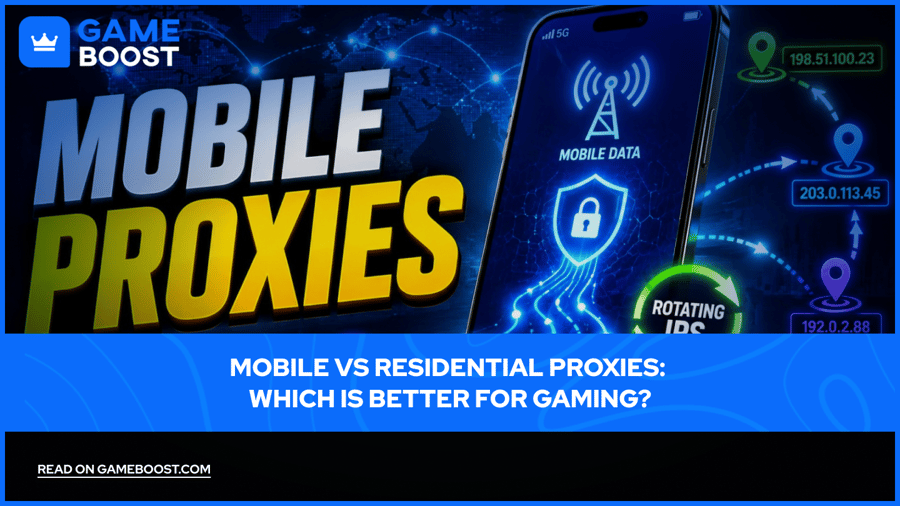
Mobile proxies route traffic through real SIM-based IPs on carrier networks, while residential proxies route through real home ISP connections, and for mobile gaming, the right choice depends on what you're actually trying to protect against. In this article, we'll break down how mobile and residential proxies actually differ for mobile gaming, which one platforms trust more, and how to decide between them based on your use case.
Also Read: 5 Best Survival Horror Games Like Outlast
Mobile proxies route traffic through SIM-based carrier IPs, while residential proxies route through real home ISP connections
Carrier-grade NAT places thousands of real phones behind the same mobile IP pool, so a flagged IP cycles back into legitimate use within minutes
Residential IPs belong to a single household, which changes how platforms judge that IP's reputation over time
Performance depends more on the game and network path than the proxy type, and mobile proxies often mirror how a real phone connects to game servers
Residential proxy speed varies with the quality of the household's broadband, which can lead to inconsistent ping
Mobile proxies cost more across the industry because carrier-grade IP pools are harder to source at scale
Residential proxies are the practical choice for geo-unlocking and casual play, while mobile proxies suit multi-account setups facing aggressive anti-fraud systems
Mobile proxies assign an IP tied to a cellular carrier, and because carrier-grade NAT puts thousands of real phones behind the same IP pool at any given time, a flagged IP doesn't stay flagged for long. It cycles back into legitimate use within minutes as other real users connect through it.
Residential proxies assign an IP tied to a single home broadband connection. It's still a real ISP address, but it belongs to one household instead of a shared carrier pool, which changes how platforms treat that IP over time.
Also Read: 5 Must-Play Action Horror Games Like Resident Evil
Performance comes down to the game and the network path more than the proxy type itself. Mobile proxies run on real 4G/5G infrastructure and on game servers optimized for mobile traffic, routing through a mobile IP can actually track closer to how a real phone connects in the first place.
Residential proxies depend entirely on the household's home connection. Some sit on fiber and perform well. Others sit on congested suburban broadband, and that inconsistency shows up as an unstable ping.
Also Read: All Resident Evil Games in Order
Mobile proxies cost more than residential proxies across nearly the entire industry. That premium pays for carrier-grade infrastructure and IP pools that are harder to source at scale. For casual play or occasional geo-unlocking, residential proxies cover the same need at a lower price point, and most providers let you buy residential proxies on a pay-as-you-go basis to test the cost difference directly.
A: It depends on the risk you're managing. Mobile proxies hold up better against aggressive anti-fraud systems since flagged IPs reset almost instantly, while residential proxies handle geo-unlocking and casual play at a much lower cost.
A: Mobile proxies run on carrier-grade infrastructure, and their IP pools are harder to source at scale. That premium is priced in across nearly the entire industry.
A: Yes. A residential IP is a real ISP address, which makes it a reliable and affordable option for early access releases and geo-locked content.
A: Neither wins by default. Mobile proxies run on real 4G/5G networks and can track close to how a real phone connects, while residential proxy performance depends entirely on the household's connection, which ranges from fast fiber to congested broadband.
Mobile and residential proxies solve different problems in mobile gaming. Mobile proxies are worth the extra cost when multiple accounts and aggressive anti-fraud systems are involved, since a flagged IP resets almost instantly. Residential proxies are the more practical pick when the goal is just a regional IP for early access or geo-locked content, at a fraction of the cost. Understanding which risk you're actually managing, ban exposure or budget, makes the decision between the two straightforward.
“ Mustafa Atteya has been writing about gaming and esports since 2023, specializing in competitive game content and player improvement guides. At 25, he brings both hands-on gaming experience and professional SEO writing expertise to the GameBoost team.”