

.png)

•Filip Premuš• 7 min read
Roblox

Last Updated: Oct 6th, 2026 - Fuse Machine pets added
Ride A Pet drops players onto a shared map to search for eggs, then sends them home to hatch whatever comes out of the shell. Every pet that emerges carries two defining numbers: base speed and base income. Speed decides how quickly a player crosses the map to reach rarer eggs, and income decides how much cash a placed pet banks with its owner while exploring somewhere else.
The gap between the roster's weakest and strongest pet is wide. A Snail crawls at 15 base speed and returns 3% income. The Griffin rides at 1.5 billion base speed and banks 500 million base income on the same card type, which makes it the top pet on both counts. Kitsune is second for speed at 1 billion, and Dragon is second for income at 300 million. Update 3 on October 3, 2026, then added the limited Fuse Machine, which hands out 16 more pets that no egg can drop.
What follows lists every pet by its base speed, income, and hatch chance, ranked from fastest to slowest, along with quick picks for the fastest mounts and the strongest early hatches, plus how mutations push those numbers well past what a stats card shows on its own.

Griffin posts the highest base speed in the roster: it rides at 1.5 billion, 50% faster than Kitsune in second place at 1 billion.
Griffin also posts the highest base income of any pet: its 500 million figure beats Dragon's 300 million by more than 1.6 to 1, and Kitsune's 90 million by more than 5 to 1.
Komodo ranks third for speed at 400 million, ahead of Dragon at 300 million, but it earns only 50 million, a sixth of what Dragon returns.
Speed and income scale together but not evenly: a pet three ranks higher can post ten times the income of the pet just below it.
Six mutations reshape every stat on a pet's card: Shocked, Volted, Rage, Void, and Eternal apply weather multipliers from 2x up to 12.5x, and the new Magma mutation from the volcano adds a 10x gamble on top of the hatched Gold, Diamond, and Rainbow mutations.
Hatch chance and stat value rarely move together: a handful of pets sit well above their listed rarity in practical value, and a few sit far below it.
Sixteen limited pets arrived with the Fuse Machine in Update 3 on October 3, 2026, and they are listed in their own section below because their speed and income have not been published.
Base speed controls how fast a mounted pet crosses the map, and that speed decides how many eggs a player reaches before an event ends. A faster mount cuts down every trip between a spawn point and the ranch. Carrying an egg starts a countdown the moment it leaves the ground, so a slow pet risks losing that egg somewhere on a long route back.
Base income works on a separate track from speed. A pet placed on the ranch banks cash automatically, with no need for its owner to stay nearby, and the income figure on that pet's stats card sets how much it earns per collection. Pets ranked below Fox display that figure as a percentage bonus, and pets from Fox upward list a flat cash number instead. Riding for speed and placing for income call for different pets, and the fastest mount on a roster is rarely the strongest earner on the same card. The Griffin is the one exception.
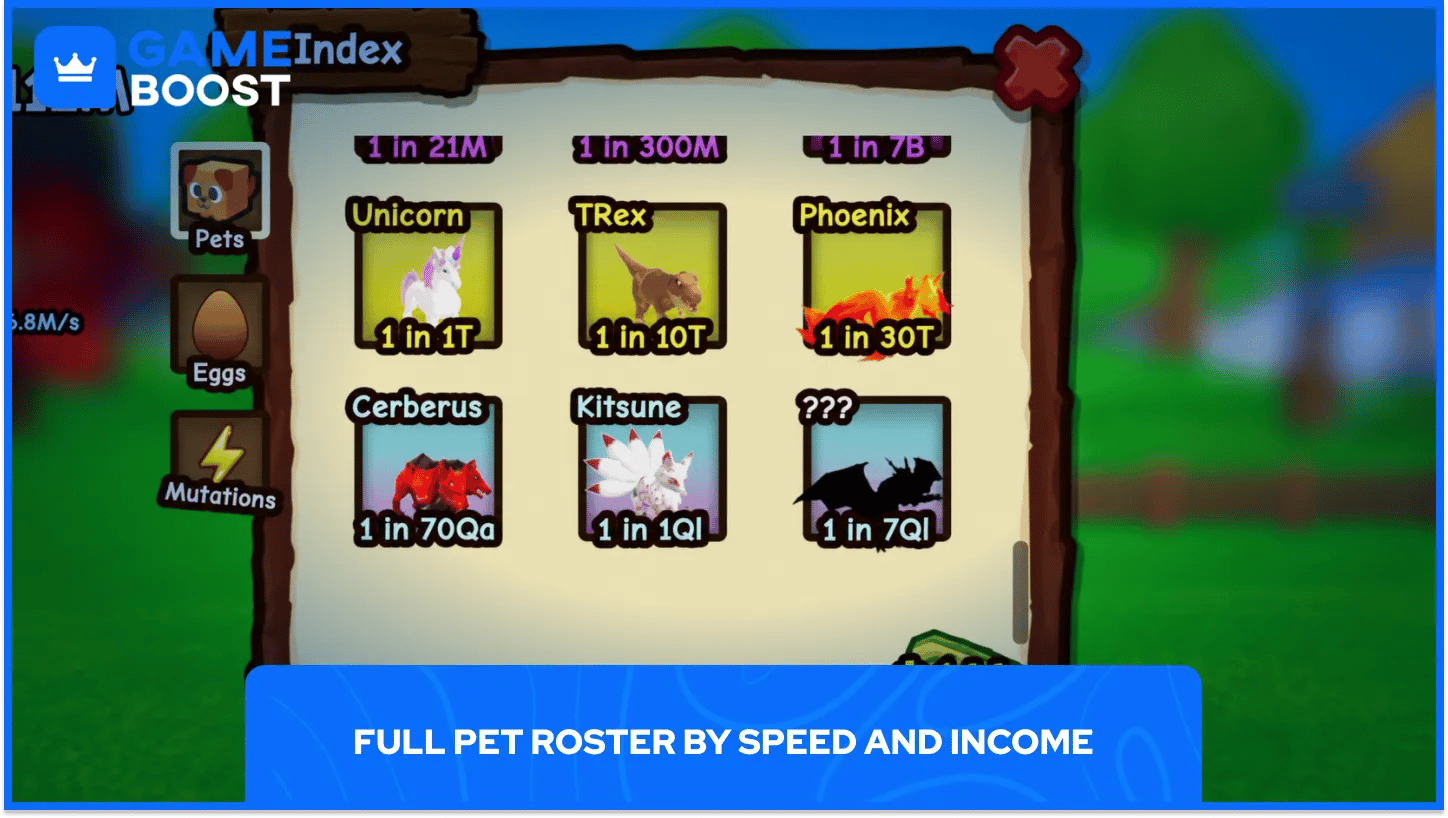
There are 37 pets in Ride A Pet that hatch from eggs, and every pet carries the same values on its stats card, including hatch chance, base speed, and base income. Lining all of them up by speed turns the roster into a single ladder instead of a set of disconnected names, which makes it easy to see exactly how much a hatch actually gains a player over what they already have mounted. Sixteen more limited pets from the Fuse Machine are listed separately below the table.
The Stage column groups pets loosely by where they tend to show up in a playthrough, from early hatches a new player replaces quickly up through the endgame pets most players build toward.
Image | Pet Name | Stage | Base Speed | Income | Hatch Chance |
|---|---|---|---|---|---|
 | Griffin | Endgame | 1.5B | 500,000,000 | 1 in 15Qi |
 | Dragon | Endgame | 300M | 300,000,000 | 1 in 5Qi |
 | Kitsune | Endgame | 1B | 90,000,000 | 1 in 1Qi |
 | Komodo | Endgame | 400M | 50,000,000 | 1 in 250Q |
 | Cerberus | Endgame | 100M | 30,000,000 | 1 in 70Qa |
 | Peacock | Endgame | TBA | TBA | 1 in 45T |
 | Phoenix | Endgame | 1M | 100,000 | 1 in 30T |
 | T-Rex | Endgame | 266K | 50,000 | 1 in 10T |
 | Flamingo | Endgame | 200k | 40,000 | 1 in 5T |
 | Unicorn | Endgame | 137K | 30,000 | 1 in 1T |
 | Monkey | Endgame | 45.5K | 6000 | 1 in 12B |
 | Cheetah | Endgame | 38.4K | 3,500 | 1 in 7B |
 | Giraffe | Endgame | 27.4K | 2,200 | 1 in 300M |
 | Boar | Endgame | 24.3k | 1800 | 1 in 50M |
 | Fox | Endgame | 19.5K | 1,200 | 1 in 21M |
 | Ostrich | Endgame | 6.96K | 750 | 1 in 1.5M |
 | Lion | Endgame | 6.52K | 510 | 1 in 1.2M |
 | Platypus | Endgame | 6k | 455 | 1 in 1M |
 | Shark | Mid | 6.10K | 400 | 1 in 1M |
 | Wolf | Mid | 5.71K | 375 | 1 in 700K |
 | Horse | Mid | 5.34K | 350 | 1 in 500K |
 | Snake | Mid | 4.78K | 240 | 1 in 180K |
 | Gorilla | Mid | 4.48K | 200 | 1 in 150K |
 | Crocodile | Mid | 3.94K | 170 | 1 in 75K |
 | Spider | Mid | 3.69K | 160% | 1 in 25K |
 | Deer | Mid | 3.25K | 150 | 1 in 9K |
 | Kangaroo | Mid | 3.05K | 120 | 1 in 3K |
 | Panda | Early | 1.38K | 50 | 1 in 1K |
 | Elephant | Early | 1.02K | 35 | 1 in 300 |
 | Pig | Early | 750 | 30 | 1 in 200 |
 | Chicken | Early | 553 | 25 | 1 in 150 |
 | Capybara | Early | 407 | 20 | 1 in 100 |
 | Koala | Starter | 300 | 5 | 1 in 50 |
 | Axolotl | Starter | 165 | 9 | 1 in 30 |
 | Sloth | Starter | 90 | 7 | 1 in 20 |
 | Turtle | Starter | 50 | 5 | 1 in 5 |
 | Snail | Starter | 15 | 3 | 1 in 2 |
Griffin leads the entire roster on two stats at once, holding both the highest base speed and the highest income in the game. Kitsune is second on speed at 1 billion, and Dragon is second on income at 300 million, but neither matches the Griffin on the other stat: Kitsune earns less than a fifth of what the Griffin does, and Dragon rides at a fifth of the Griffin's speed. Income climbs in sharp jumps rather than a smooth curve, since Cerberus earns three hundred times more than Phoenix even though only Peacock sits between them on the table.
Panda is faster than Elephant (1.38K to 1.02K), even though Elephant hatches earlier. Checking a new hatch against the row directly above and below it is the fastest way to confirm it is a genuine gain rather than a sideways move.
Update 3, released on October 3, 2026, added the Fuse Machine, a limited-time machine that turns four pets of Legendary rarity or higher plus a Cash fee into one fused pet. There are 16 fused pets, and none of them can be hatched from an egg. Their speed and income have not been published yet, so they are not ranked in the table above.
Rarity | Fused Pet |
|---|---|
Legendary | Okapi, White Tiger, Anaconda |
Mythic | Black Stallion, Scorpion, Grizzly, Jackalope |
Divine | Black Panther, El Toro, Stone Golem, Fenrir |
Ethereal | Hellhound, Hydra Dragon, Llama Cow, Fennec, Highland Cow |
The machine unlocks after Rebirth 1 and stands to the left of the Ride Pet With Friends board near spawn. For the full process, odds, and costs, see our Fuse Machine guide. The machine was promoted as limited-time, so check that it is still available in the game.
Ten pets separate themselves from the rest of the roster by raw scale, and the gap between the slowest pet on this list and the fastest spans more than four orders of magnitude. Every pet on this list also posts income as a flat cash number rather than a percentage bonus, which is not true of anything ranked below it.
Ranked fastest to slowest, the top ten currently stand as follows.
Griffin – 1.5B base speed
Kitsune – 1B base speed
Komodo – 400M base speed
Dragon – 300M base speed
Cerberus – 100M base speed
Phoenix – 1M base speed
T-Rex – 266K base speed
Flamingo – 200K base speed
Unicorn – 137K base speed
Monkey – 45.5K base speed
Peacock's speed has not been published yet, so it is not ranked.
The Griffin's 1 in 15Qi hatch chance is the longest in the game, with Dragon's 1 in 7Qi and Kitsune's 1 in 1Qi behind it, so Griffin wins the speed race and is also the hardest pull. Phoenix marks a useful middle ground for a player without an S-tier pet yet, since it breaks a million base speed and still hatches at odds far shorter than Peacock, Cerberus, or anything above them.
For most players, Cheetah, Monkey, or Unicorn end up as the realistic ceiling for a long stretch of a playthrough, and the pets above them function more as long-term targets than pets to plan an entire session around. Riding whichever pet sits highest on this list still beats riding a mid-tier pet for covering ground, even when that top pet lacks the income to match.
A new player hatches most of the weakest pets in the game before they ever see a mid-tier egg, and not every early hatch deserves an equal amount of attention. Some of the starter and early-tier pets carry a real edge over the others in their group, either through a stronger income figure or a jump score that outperforms how early the pet actually hatches.
A few picks from the lower half of the roster stand out and are worth keeping over the alternative in the same tier.
Panda posts the highest income in the early tier at 50%, well ahead of Elephant in second place, and it makes a solid ranch placement before a player reaches anything in the mid tier.
Elephant is the first pet on the hatch ladder to break 1,000 base speed, a real step up from Pig at 750, although Panda edges it out at 1.38K speed and earns more.
Koala posts a 300 base speed, nearly double Axolotl's 165, the best of the starter pets, which makes it worth mounting early even though its income sits near the bottom of the table.
Axolotl posts the highest income among the true starter pets at 9%, a small edge over Sloth and Turtle that still adds up over a long ranch session.
None of these four pets belong in a long-term plan, and a player should still replace each one the moment a mid-tier egg opens up a real alternative. Picking the strongest option inside a weak tier just shortens the time spent waiting for that replacement, since a slightly better starter pet still reaches the next egg or banks the next dollar faster than the weakest one in the same group.
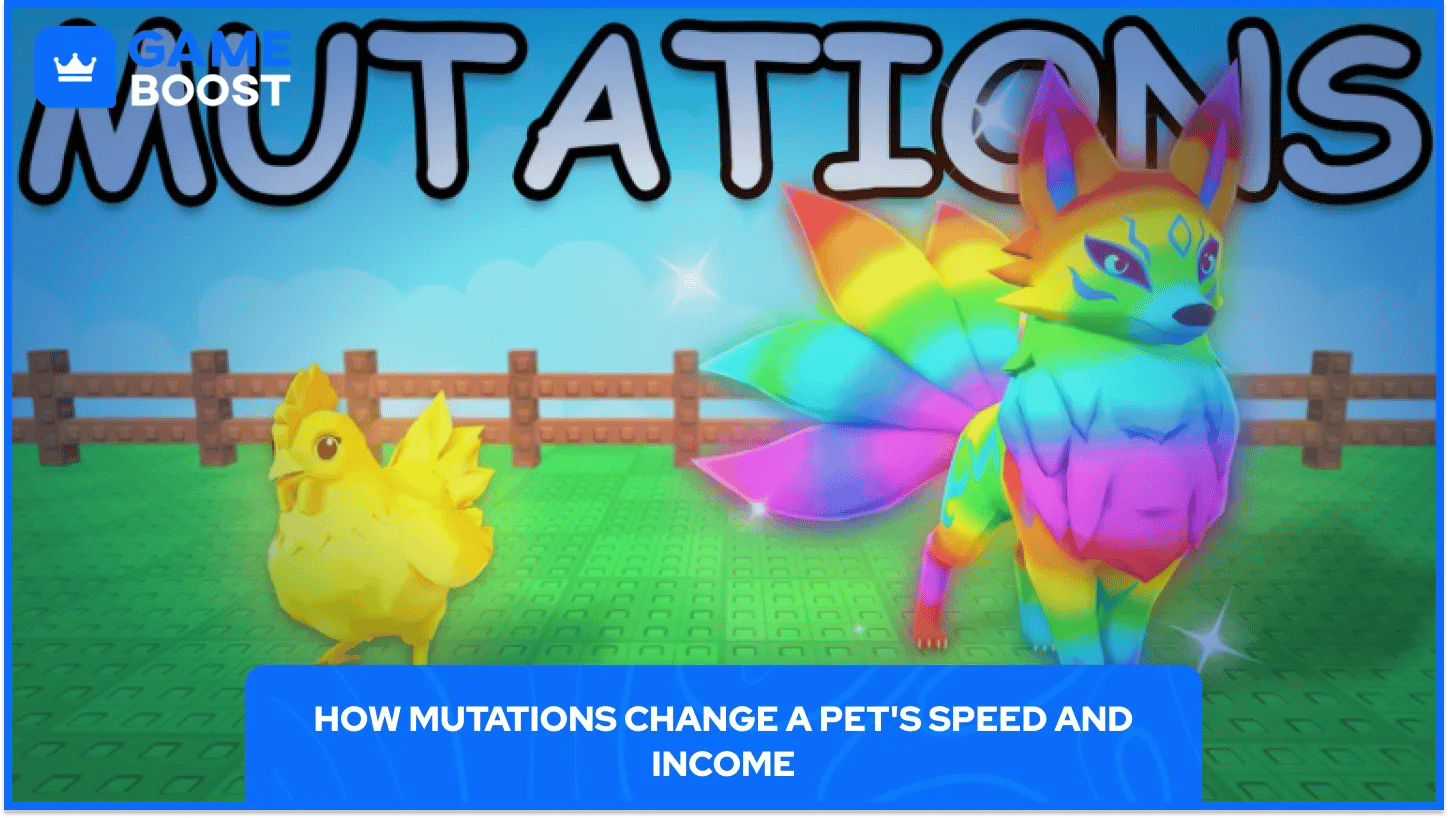
Three separate systems apply mutations, and they do not touch the same stats. A Weather Trait comes from a storm and multiplies speed and money. A Hatched Mutation has a small chance to appear the moment an egg opens and multiplies money and speed together. The Magma mutation comes from dipping an egg into the volcano's lava, and was added with the Volcanic Update.
Weather Traits and their speed multipliers run in the order below.
Weather Trait | Speed Multiplier |
|---|---|
Shocked | x2 |
Volted | x3 |
Rage | x4 |
Void | x7 |
Eternal | x12.5 |
A pet can only hold one Weather Trait at a time, and a stronger storm always replaces a weaker trait already in place. A weaker trait can never overwrite a stronger one.
Hatched Mutations sit alongside that system rather than inside it, since a player rolls for one at the moment of hatching instead of chasing it through weather.
Hatched Mutation | Hatch Chance | Money Multiplier | Speed Multiplier |
|---|---|---|---|
Gold | 10% | x2 | x2 |
Diamond | 1% | x7 | x7 |
Rainbow | 0.1% | x15 | x15 |
Magma Mutation: Take an egg to the volcano and drop it into the lava for a 15% chance to apply Magma, which multiplies a pet's speed and money by x10. Each egg gets only one attempt. A success adds 8 seconds to the egg's timer, while a failure removes 5 seconds, so run the dip with enough time on the clock.
A pet can carry one Weather Trait and one Hatched Mutation at the same time, so an Eternal pet that also hatched with Rainbow stacks both speed bonuses on the same card. Rainbow's 0.1% hatch chance makes it the harder of the two systems to land, even though its multiplier sits far below Eternal's x100 on speed alone.
A single pet rarely wins on both fronts, and the Griffin is the one exception. Below it, the fastest pets from Cheetah through Kitsune post income figures well below what Dragon or Komodo return, and the strongest earners give up real ground on raw speed. Kitsune rides at 1 billion but earns 90 million, while Dragon earns 300 million but rides at 300 million. Most players end up building toward two separate pets, one mounted for travel and one parked on the ranch for cash, until a Griffin makes one pet enough.
Kitsune and Dragon are the clearest example of this trade-off, since Kitsune wins the speed race and Dragon wins the income race among the pets below the Griffin. Placing pets follows a simpler rule than riding them, since a ranch slot only cares about the income figure on the card and nothing else. The strongest-earner placement option on the ranch screen sorts that automatically, which removes any real reason to place earners by hand once a player has more than a handful of pets.

Picking a pet in Ride A Pet comes down to matching a number to a goal instead of chasing whatever looks strongest on a hatch screen. A player short on cash gets more value from an income-heavy pet parked on the ranch than from a faster mount that spends its time sitting idle, and a player stuck on a slow egg route gets more from speed than from a small income bump.
Mutations reward planning instead of being left to chance, and the new Magma dip adds one more way to push a pet past its card. Parking a strong pet inside the ranch before a weather event costs nothing and can turn a mid-tier pet into a real upgrade over an unmutated rare one. Building toward Kitsune, Dragon, or the Griffin still makes sense as a long-term target, but the pets sitting between them are what actually carry most of a playthrough.
“ Hamza is your average video game enthusiast who’s always looking for his next game to play. Whether he’s diving into a competitive multiplayer match, exploring a massive open world, or getting completely hooked on a new release, gaming has always been one of his favorite ways to spend his time. Over the years, his love for games has grown into a passion for understanding and sharing everything about them. Through his articles, Hamza aims to help gamers discover new games, improve their skills, stay up to date with the latest gaming news, and get the most out of their favorite titles.”