


•Patrik Mršnik• 5 min read
Games
The Graveyard Keeper 2 tech tree decides what your keeper can build, forge, grow, and cook, and it does very little to explain itself. It holds 236 technologies across six sectors, paid for with red, green, and blue Graveyard Keeper 2 tech points, and plenty of nodes depend on research from a completely different sector.
That's why the tech tree got its own section in our Graveyard Keeper 2 review. The tutorial covers the first few chores and then leaves you alone with a screen full of branches. I spent points on whatever looked appealing early on instead of following quest requirements, and that caused a run of early mistakes.
Lazy Bear Games and tinyBuild released the game on September 22, 2026, and the Graveyard Keeper 2 Steam page pitches it as a medieval cemetery management sim with zombie-run production. Every bench those zombies work at starts life as a node in the tree.
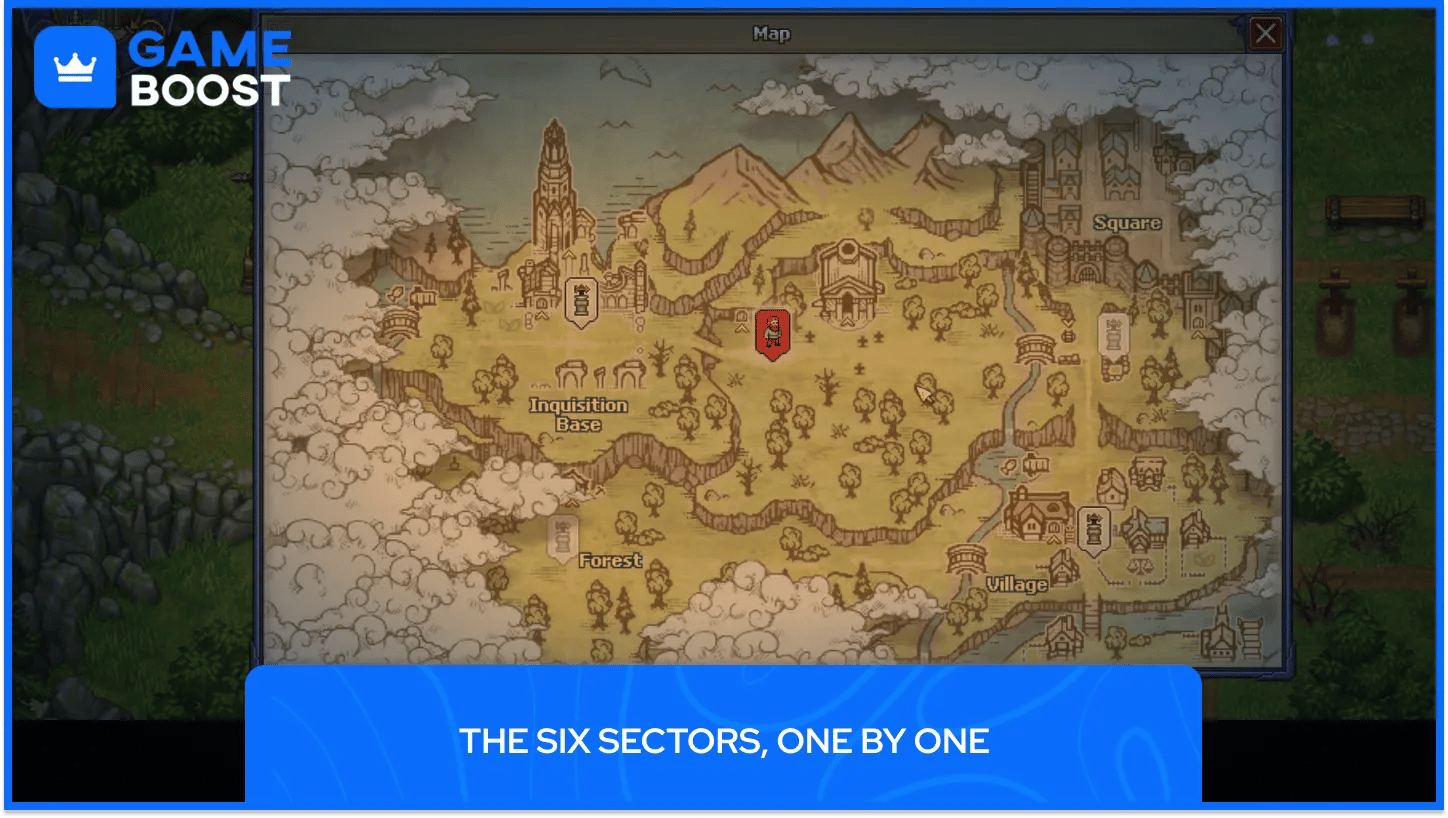
Below, we go through all six sectors one at a time. After that come the point sources, the hidden parts of the tree, and the split between tech points and Inspirations.
The Graveyard Keeper 2 tech tree has 236 technologies in six sectors: Building, Metallurgy, Farming, Theology, Anatomy and Alchemy, and Cooking.
Community tallies put the full tree at 11,157 red, 5,129 green and 4,132 blue points. The story path needs only about 288 red and 65 green.
Building and Metallurgy run on red, Farming on green, and Theology is the only sector where blue is the largest share. Cooking is free.
Blue tech points are scarce early. Autopsies pay them first, and the Study Table turns rare items into big payouts later.
Red is the long-run gap: studying every item covers the green and blue bill but less than half the red one.
Hidden question-mark nodes and cross-sector requirements such as the Magic Bell are why the tree feels opaque.
Inspirations and Mastery are a separate system. A missing recipe points to the tech tree, a blocked action points to Mastery.
You open the Graveyard Keeper 2 tech tree from the character window, pick a node, check what it grants and pay its cost in colored tech points. Every node after the first in a line waits on the node before it, and a node with two parents needs both of them researched first.
Red points come from hands-on material work like mining and stone cutting, green from nature and farming, and blue from the scientific and spiritual side of the job. According to one community wiki, each color caps at 999 points and anything earned past that is lost, so a big unspent pile is a real risk.
You'll never need the whole tree for the story. All 20 Cooking nodes are free, and 10 reputation nodes cost nothing either. Each one fills in once a character likes you enough, and it only shows up the next time you open the tree after crossing that threshold.
Researching a node rarely finishes the job. The tech hands you a recipe or a workstation blueprint, and you still have to build the bench, gather its materials and craft the item. Anyone who expects a node to drop a finished tool into their inventory ends up staring at a recipe they can't make yet.
Sector | Technologies | Red | Green | Blue |
|---|---|---|---|---|
Building | 54 | 4,470 | 257 | 670 |
Metallurgy | 47 | 3,680 | 330 | 340 |
Farming | 34 | 5 | 2,575 | 360 |
Theology | 31 | 930 | 795 | 1,120 |
Anatomy and Alchemy | 50 | 2,072 | 1,172 | 1,642 |
Cooking | 20 | 0 | 0 | 0 |
Totals above are full-sector costs from community data. Read them as a farming guide: the color a sector eats is the color you'll grind during your time in it.
Building, Metallurgy and Farming are all open the first time you wake up at home, and Building starts with The Concept of Wood, which the game gives you for free. It leads straight into Chopping, Woodworking I and The Concept of Stone, so your first days go here whether you plan it or not.
It's the biggest sector at 54 nodes, and about 83% of its cost is red. Jack's three reputation nodes, at 40, 50 and 70 reputation, sit in this tab.
Bronze Works (5 red) roots the sector and gives you the anvil. Bronze details need three nodes in a row (Bronze Works, Bronze Melting and Bronze Craft) for 45 red in total. Players often mix up Bronze Works and Bronze Craft, and only the second one lets you make bronze details after melting.
From there the line runs through bronze tools and equipment toward iron and steel. Roughly 85% of the sector's cost is red, and Herbert's reputation node (20 reputation) lives here.
Farming is the green sector, with 2,575 of its 2,940 points in green and just 5 red. It opens with two starting nodes, Gardening (5 green) and Orchardry, which makes it the cheapest place to spend your first green points.
Theology stays locked until you meet the Nun. It starts with Writing Basic and is the only sector where blue takes the biggest share of the cost, at 1,120 of 2,845 points. Gunter has a reputation node here at 20, and the Nun has two, at 30 and 50.
This tab opens the first time you use the autopsy table. It starts with Alchemy, Basic and a free Albert node at 10 reputation, and it's the most mixed sector in the game, costing 2,072 red, 1,172 green and 1,642 blue. Gunter (20) and the Nun (25) each have a reputation node here too.
Cooking has nothing to buy. Its 20 dishes appear as you do things in the world, such as eating raw flesh, harvesting a new crop, repairing tables or baking pies. If a Cooking node sits empty, the fix is an action outside the menu.
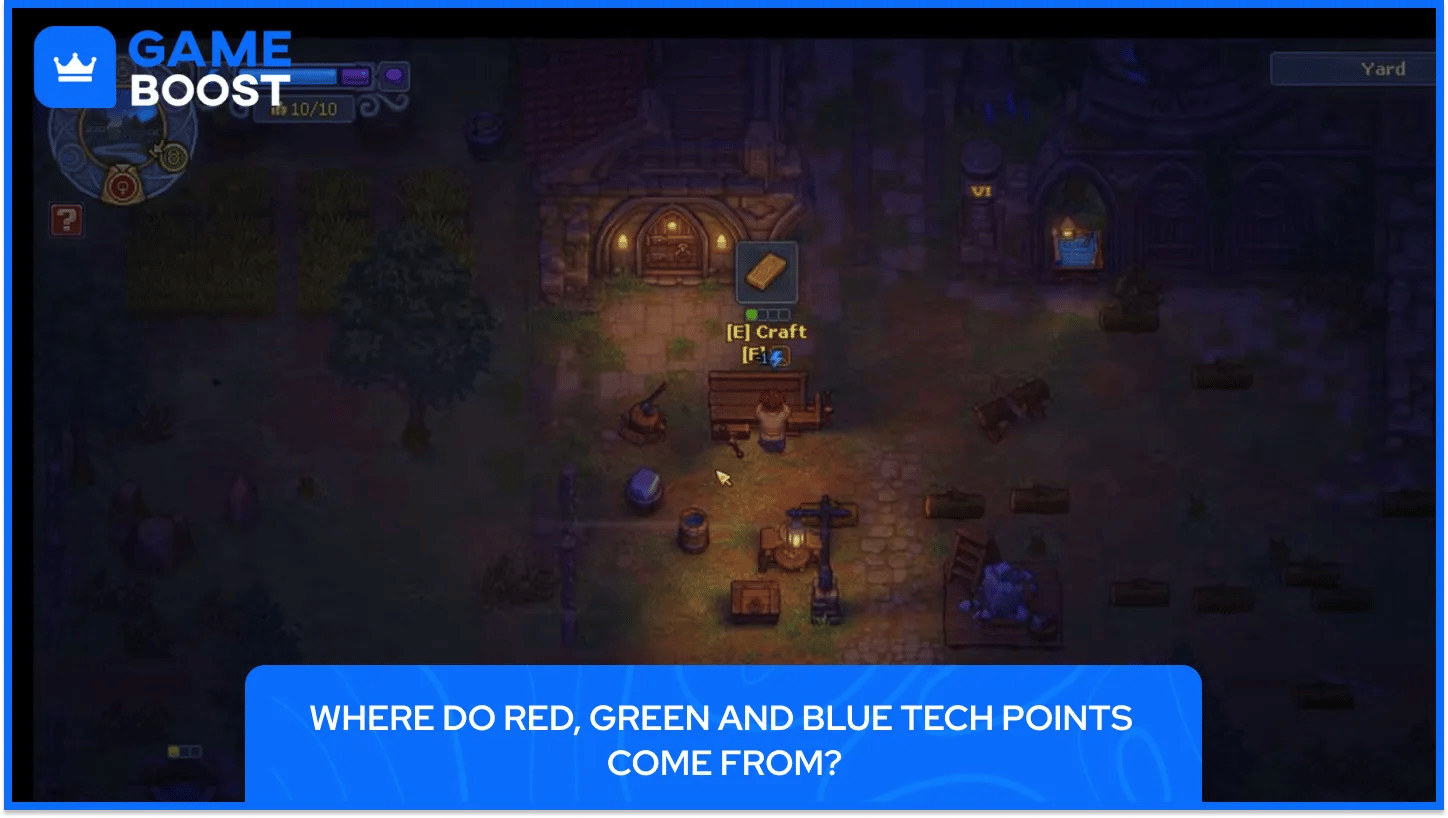
Almost every job in Graveyard Keeper 2 drops tech points, and the job decides the color. Mining and clearing junk pay red, harvesting and picking plants pay green, and finishing a workbench pays red with a little blue on top. Autopsies are the steady early source of blue.
Activity | Colors | Typical yield (community data) |
|---|---|---|
Harvesting crops, picking plants | Mostly green | Small, per resource |
Mining stone, clearing junk | Mostly red | Small, per resource |
Finishing a workbench build | Red, some blue | 1–10 |
Crafting at a bench | Depends on the bench | 1–3 per item |
Autopsy work | Red and blue | 1–3 blue per organ |
Studying an item at the Study Table | Any color | 10 up to a few hundred, once per item |
Techbooks | One color | 25 or 50 per book |
Blue tech points are the hardest color to build up early, since only a few jobs pay them. The Study Table is the long-term answer: it consumes an item once in exchange for points and costs Science, which you make from items like clean paper and science kits. Save it for rare items such as organs, potions and top-tier gear. One community breakdown puts the Necronomicon at 300 blue from a single study.
Over a full playthrough, red becomes the tighter color. Community counts of every possible study land at roughly 5,000 red, 6,300 to 6,500 green and 5,200 to 5,400 blue. That covers the whole tree's green and blue cost, but less than half of the 11,157 red it asks for. Keep mining, smelting and cutting stone long after blue stops being a problem.
Graveyard Keeper 2 shows costs and links on every node and almost never says where a branch leads. Some nodes start as question-mark blocks and only reveal themselves after a quest step, a finished recipe or a visit to a new location. You can't plan around a node you can't see.
Requirements also cross sector lines without warning. A quest item like the Magic Bell needs blood from corpse processing and a bronze ingot from Metallurgy. A player who poured everything into Building hits that wall with no hint it was coming.
Node icons leave things out as well: some technologies grant more than their icons show. Combine that with the hidden nodes, and the tree reads like a map with half the roads missing.
My fix was to treat quest requirements as the real roadmap. Quests name the exact items the story needs next, and tracing an item back through its recipe points you at the right node. For a view of the whole tree, expect to open a wiki at least once.
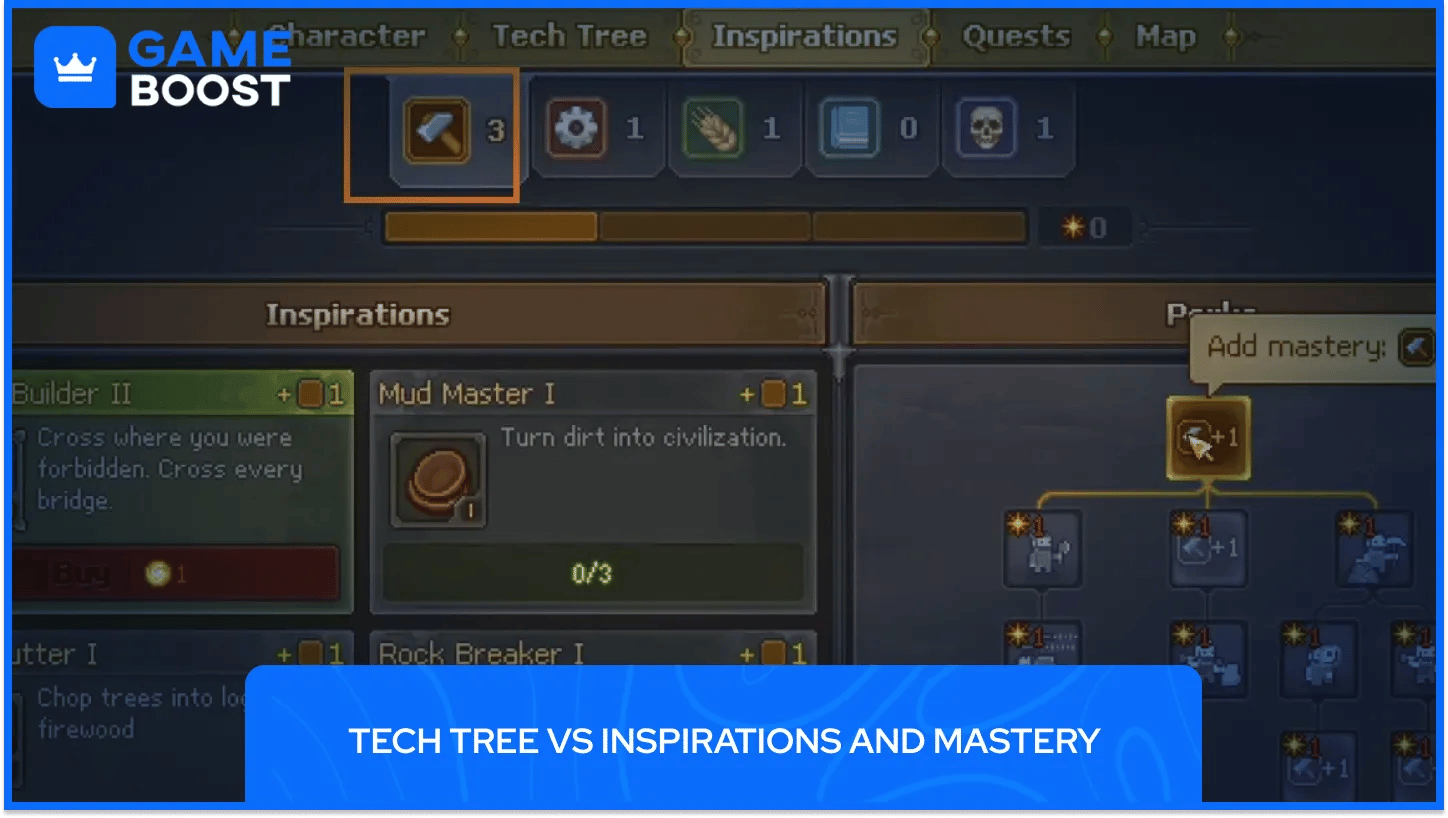
Tech points buy recipes, buildings and workstations. Graveyard Keeper 2 Inspirations are a separate set of perk nodes, filled by doing specific jobs, and they raise Mastery in trades like building, farming and theology. Mixing the two up is an easy way to get stuck.
Mastery decides whether you can do a job at all. Bigger trees, rocks and obstacles need a higher Mastery level, and tech points won't get you past them. On the Steam forums, a player hunting for iron learned that opening the iron mine takes dynamite and a hammer crafting proficiency of 8. Other players suggested mining loose iron nodes near the mine, the swamp, the vineyard and the forest, then crafting iron tools to raise that level.
Early Inspiration steps are free, later ones ask for Faith, and Faith also pays for fast travel points. It trickles in slowly, and Steam reviewers keep pointing to it as a brake on progress. A perk you buy today can leave a Mastery gate unpaid two days later.
A missing recipe means a tech node, and a blocked action means Mastery. Zombie workers also have skills of their own, and raising your keeper's Mastery does nothing for the undead at the bench.
Cheap early nodes carry the first days. Bronze Works costs 5 red, Gardening 5 green, Chopping 8 red, Woodworking I 10 red and The Concept of Stone 15 red. Together they cover the anvil plus the first wood, stone and garden recipes.
Add the bronze line next. Bronze Melting and Bronze Craft finish the 45-red path to bronze details. The Magic Bell is one quest item that can't be made without a bronze ingot.
Story progress costs little. Community tallies put the path through all fifteen chapters at roughly 288 red and 65 green, with very little blue. Everything else you earn can go into automation, better tools and Theology, and there's no reason to panic-spend on day two.
Spend down any color that gets close to 999, and keep Study Table visits for rare items over wood and ore. When a quest names an item you can't craft, trace it back through the tree before buying anything new.
The Graveyard Keeper 2 tech tree rewards order more than volume. Points come easily once benches and autopsies run every day, and what runs short is knowing which node the next quest actually needs. Read the tree backward from the quest, and it stops looking like a wall of branches.
Guard your Faith harder than your tech points. Tech points refill with every chore, but Faith feeds both Inspirations and fast travel and arrives slowly, so it decides how fast your keeper can take on bigger jobs.
The tutorial stops early, question-mark nodes hide the long-term plan, and node icons don't list everything a technology grants. Nobody outside Lazy Bear Games knows yet whether post-launch patches will clear any of that up.
Until then, let the quests set the order and keep mining red long after blue stops hurting. Once the bronze line and the first autopsy upgrades are in place, the rest of Graveyard Keeper 2 starts to make sense.
Graveyard Keeper 2 Game Key
View all GameBoost Game Keys
View all GameBoost Accounts
View all GameBoost Boosting Services
View all GameBoost Currencies
View all GameBoost Gift Cards
View all GameBoost Top Ups
View all GameBoost Items
“ A former sports journalist and editor, Patrik joined Gameboost SEO team in 2026. He has spent most of his life playing Football Manager, but his sphere of interests spreads through whole gaming universe.”