
.png)

•Hamza Rashid• 10 min read
League of Legends
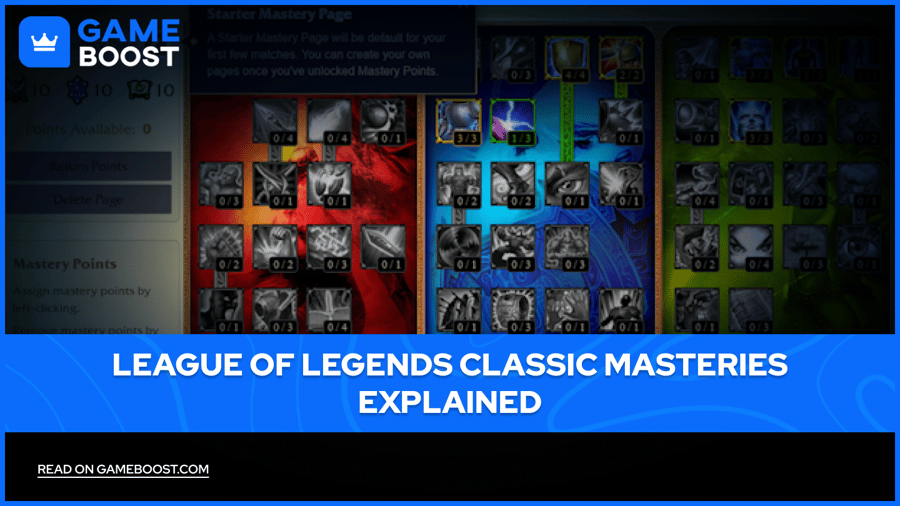
Masteries are the second half of the League of Legends Classic power-up system, sitting right next to Runes on your pre-game setup screen. Where Runes give flat stat boosts, Masteries change how your champion actually behaves in combat, adding effects like bonus execute damage, empowered recalls, or extra gold from minions.
Unlike Runes, Masteries don't cost a single Influence Point. They're free the moment they open up, which means the real skill isn't earning them; it's knowing where to spend your points.
This guide covers what each Mastery Tree does, how the point system works, and how to build a page that actually fits your champion instead of copying a generic split.

Masteries open at Level 3 in LoL Classic and cost nothing to use, unlike Runes, which are earned or bought.
There are three Mastery Trees: Offense, Defense, and Utility, each built around a different playstyle.
You get 30 total Mastery Points, and spending 21 in a single tree opens its strongest, final Mastery.
Each tree has six rows, and a new row opens for roughly every four points you invest in that tree.
The standard split is 21 points in a main tree and 9 in a secondary tree, rather than spreading points evenly across all three.
You can save multiple Mastery Pages and swap between them per champion, similar to Rune Pages.
If you forget to set a page before a match, League Classic automatically assigns a default one for you.
Masteries are a point-allocation system that layers combat modifiers on top of your champion's kit. Instead of a flat stat bonus, each Mastery does something specific: extra damage against low-health enemies, reduced damage taken from monsters, faster ward placement, or bonus experience early in the game.
You build a Mastery Page the same way you build a Rune Page, then select which one to bring into champion select. Because Masteries are free, there's no reason to hold off on experimenting once they're available at Classic Level 3.
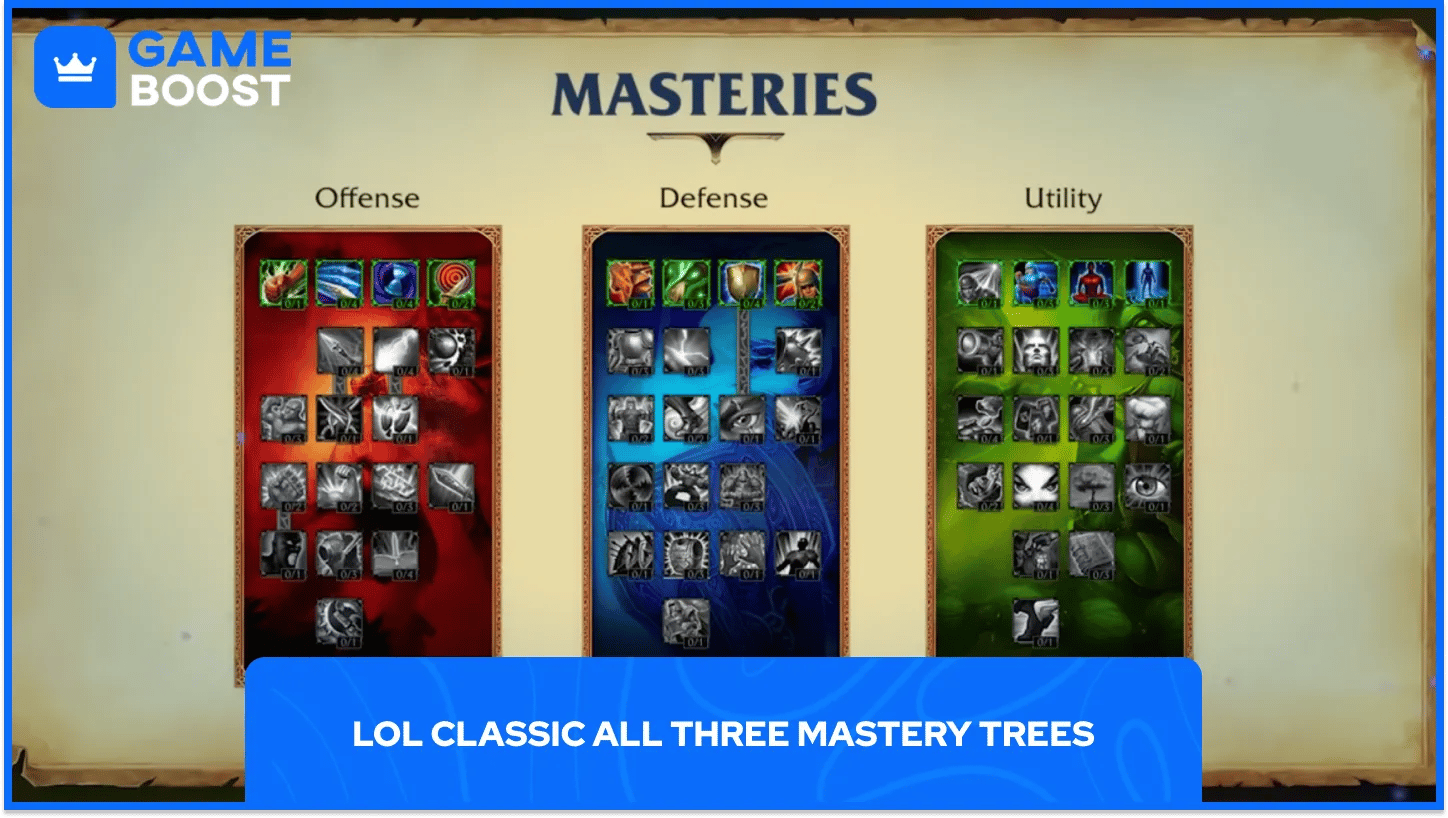
Each tree pulls your champion toward a different build, and most players end up leaning heavily into just one. The three trees don't overlap much in what they offer, so your choice of main tree says a lot about how you plan to play the game.
Picking the wrong one for your champion's role usually shows up fast, either through weak trades in lane or a squishier than expected teamfight presence.
Tree | Focus | Best For |
|---|---|---|
Offense | Bonus AD/AP, penetration, attack speed, execute damage | Assassins, duelists, lane bullies |
Defense | Armor, health, magic resist, reduced monster damage | Tanks, junglers, squishy champions needing survivability |
Utility | Mana regen, bonus gold, extra XP, faster wards | Supports, mana-hungry mages, early-game scaling picks |
The Offense tree's final Mastery, Executioner, adds bonus damage against low-health targets, and it's strong enough that most damage-focused champions build straight toward it. The Defense tree leans more passively, handing out flat resistances that matter most in extended fights. Utility is the odd one out: it rarely wins a fight on its own, but it keeps mana-dependent champions and Supports functional through the early game.
Also Read: Don't Share Your League of Legends Account for These Reasons
League Classic gives you 30 points to spend total, and every point goes into one of the three trees. Each tree contains six rows of Masteries, and a new row opens for roughly every four points you commit to that tree.
Rows scale in strength as you go deeper. Some Masteries in the same column are linked, so you need to max out the earlier one before the game lets you invest in the one below it. Reaching a tree's sixth and final row, its strongest single Mastery, takes 21 points committed to that tree alone.
That 21-point threshold is the reason most Mastery pages follow the same rough shape: 21 points in one tree to grab its best Mastery, and the remaining 9 spread into a second tree for a smaller bonus. Splitting points evenly across all three trees, something like 10/10/10, sounds balanced but actually leaves you short of every tree's strongest effects.
Buy League of Legends Accounts

Your Mastery split should follow your champion's job, not a one-size-fits-all template. A few starting points to work from:
Damage-focused champions go Offense-Defense. Assassins, duelists, and most junglers want 21 points in Offense for the damage and execute bonuses, with 9 in Defense to survive dives and skirmishes.
Fragile champions lean Defense as their secondary. Squishy mages and marksmen benefit from the extra health, armor, and magic resist far more than a marginal damage increase.
Mana-hungry mages and Supports go Utility-heavy. 21 points in Utility keeps your abilities flowing and adds gold or XP that a Support especially can't earn from last-hitting minions.
Aggressive Supports sometimes split three ways. Champions who both fight and enable, like early-game engage Supports, occasionally spread points across all three trees instead of committing to one.
Match your secondary tree to your matchup, not just your kit. A champion built to go Offense-Defense might switch that secondary to Utility against a lane where sustain and mana matter more than raw survivability.

In League Classic Runes and Masteries both shape your champion before the game starts, but they solve different problems. Runes hand you flat, predictable stats like extra attack damage or armor, bought individually with Influence Points and locked to whatever you've already purchased.
Masteries work through effects instead of raw numbers, and they're free from the moment they open up. Where Runes reward the IP you've saved, Masteries reward the point allocation you choose, so building the two together, matching your Rune Page's stats to your Mastery Tree's strengths, gets far more value than treating them as separate decisions.
Also Read: How to Delete Your Account in League of Legends

A: In League of Legend Classic Masteries open at Level 3 while Runes start opening at level 4, so Masteries are actually available slightly earlier.
A: No. Masteries are completely free to use once they're available in League Classic. Only Runes and extra Rune Pages cost IP.
A: In LoL Classic, committing 21 points to a single tree opens that tree's strongest Mastery present in the sixth row.
A: The standard mastery split looks like 21 points in a main tree and 9 in a secondary tree. Splitting evenly across all three trees usually leaves you weaker in every one.
A: Yes. You can build multiple pages and pick the right one per champion, the same way you would with Rune Pages.
Masteries reward a bit of planning more than raw grinding, since every point is free the moment your LoL Classic Level allows it. Pick a tree that matches your champion's job, commit 21 points to unlock its strongest effect, and use the remaining 9 to patch whatever weakness your kit still has. Pair that with a Rune Page built around the same stats, and your champion walks into lane with a setup that actually fits how you plan to play.
Buy LoL Skins
Buy Riot Points
League of Legends Boosting Service
LoL Accounts
View all GameBoost Accounts
View all GameBoost Boosting Services
View all GameBoost Currencies
View all GameBoost Game Keys
View all GameBoost Gift Cards
View all GameBoost Top Ups
View all GameBoost Items
“ Hamza is your average video game enthusiast who’s always looking for his next game to play. Whether he’s diving into a competitive multiplayer match, exploring a massive open world, or getting completely hooked on a new release, gaming has always been one of his favorite ways to spend his time. Over the years, his love for games has grown into a passion for understanding and sharing everything about them. Through his articles, Hamza aims to help gamers discover new games, improve their skills, stay up to date with the latest gaming news, and get the most out of their favorite titles.”