



•Filip Premuš• 4 min read
PoE2
101 offers available






Popular Categories:
Trusted by Millions of Gamers Worldwide

Excellent 4.9 out of 5.0
Based on 349,136+ orders

Al*****ia
Spain
Good communication, fast!! im recommend
Ma*****nn
Germany
2 time ordering 2 time positive i like this shop very much www
ki*****on
Bulgaria
he was very nice plus added a little bonus would recommend
co*****77
Ireland
No complaints is a legit seller
ju*****el
Germany
Betellung erhalten leider nicht schnel aber trotzdem gut
No*****gk
Germany
It was all good it was really fast and i got what i wanted!:)

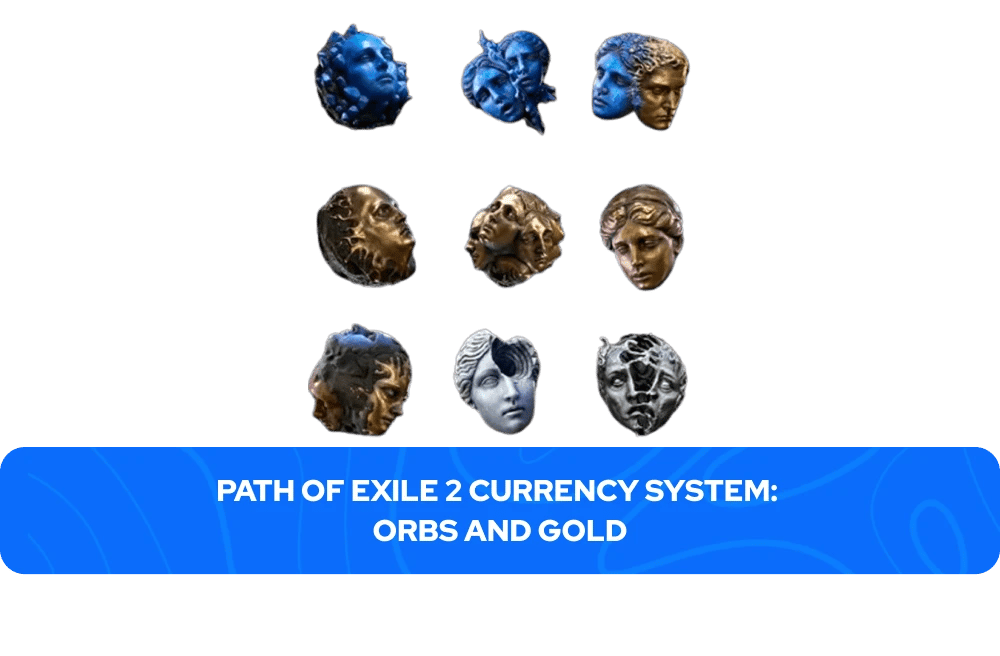
Path of Exile 2 does not use a single unified currency like gold coins for player-to-player trading. Instead, the game runs on a collection of orbs, shards, and other items that each carry a specific function, acting as both crafting materials and the primary medium of exchange between players. Gold does exist in PoE 2, but its role is limited to NPC transactions such as purchasing base items or respeccing passives at vendors. Gold in POE 2 does not drop from monsters and cannot be traded between players, which is an intentional design decision that keeps the orb economy as the only real trading layer in the game.
PoE 2 currency items drop from defeating monsters, opening chests, or selling gear to NPCs in town, and they connect directly to the trading system since rare orbs can be exchanged for powerful gear or converted into lower-tier orbs needed for crafting. Players who run low on specific orbs can also build up supply through shards: disenchanting magic items yields Transmutation Shards, disenchanting rare items gives Regal Shards, and once ten shards of the same type are collected, they combine automatically into a full orb. This gives players a consistent way to get PoE 2 currency even during sessions where direct drops are sparse.

Players who want to buy PoE 2 currency, buy PoE 2 divine orbs, or pick up a specific supply of PoE 2 exalted orbs or chaos orbs can find listings of PoE 2 currency for sale across all major orb types on GameBoost. The platform connects buyers with verified sellers who coordinate delivery directly through the game, so orders are fulfilled through actual in-game trades rather than automated systems. Delivery timing varies depending on seller availability at the time of purchase, which is standard for a marketplace model.
To buy PoE 2 currency and place an order on GameBoost, players select the orb type and quantity, enter their character name, complete checkout, and then wait for a seller to get in touch through the platform. From there, the trade is arranged in-game. Path of Exile 2 currency for sale on GameBoost covers the orbs that actually drive progression, including divine orbs, exalted orbs, and chaos orbs, giving players access to the specific PoE 2 orbs for sale that matter most at their current stage of the game.
Each PoE 2 orb interacts with different affixes, item tiers, and numeric values, which makes Path of Exile 2's loot-driven progression feel layered rather than flat. Some PoE 2 orbs are plentiful early in the campaign and serve a clear purpose at that stage of progression, while others are rare enough that players treat them as high-value Path of Exile 2 currency for trade rather than disposable crafting tools.
Here is a list of core Path of Exile 2 currency orbs and their uses:
Orb | Effect | Typical Use |
|---|---|---|
Orb of Transmutation | Upgrades a Normal item to Magic with one modifier | Early gear progression |
Orb of Augmentation | Adds a second modifier to a Magic item | Early gear progression |
Regal Orb | Upgrades a Magic item to Rare, adding one modifier | Bridge to high-tier crafting |
Chaos Orb | Re-rolls all modifiers on a Rare item randomly | Mid-tier crafting and trade |
Exalted Orb | Adds a new random modifier to a Rare item | High-tier crafting and trade |
Divine Orb | Re-rolls the numeric values of all modifiers on an item | Endgame crafting and top-tier trade |
Orb of Alchemy | Upgrades a Normal item directly to Rare | Map and gear preparation |
Orb of Annulment | Removes one random modifier from an item | Precision crafting |
Orb of Chance | Randomly upgrades a Normal item, with a rare chance to become Unique | Situational use |
Orb of Regret | Grants one passive skill tree respec point | Build adjustments |
Divine Orbs stand out as the primary currency for high-value trades, and they re-roll numeric values on items rather than changing which modifiers appear, so a Tier 5 Life modifier that ranges from 80 to 89 will stay within that range after a Divine Orb is applied, with the actual number re-rolling anywhere inside those bounds. Exalted Orbs work differently: they add a completely new random modifier to a Rare item rather than altering existing ones, which makes them the preferred tool when a well-crafted item is missing one final affix.
Using currency in Path of Exile 2 follows a consistent process across all orb types: right-click the orb, then left-click the item players want to modify. Holding Shift allows the same currency to be applied repeatedly without needing to right-click each time, which saves time during bulk crafting.
Timing matters just as much as technique when it comes to applying PoE 2 orbs. Each orb fits a specific stage of progression, and using one too early or on the wrong item is one of the most common ways players burn through currency without meaningful results.
Orbs of Transmutation and Augmentation work best on bases that already carry a strong prefix or suffix, since applying them to a good base extracts more stat value from a limited currency supply.
Regal Orbs serve as the transition point between magic and rare gear, increasing the maximum number of modifiers from two on a Magic item to six on a Rare item, which opens the door to further refinement with Exalted or Chaos Orbs afterward.
Chaos Orbs re-roll all modifiers on a Rare item at once, making them a high-risk tool best saved for gear that is close to what a build needs but missing one or two key stats.
Exalted Orbs are best applied to a Rare item with four to five already solid modifiers, since they add one new random affix rather than replacing existing ones.
Divine Orbs re-roll the numeric values of all modifiers simultaneously, so players should apply them only to items where the base modifiers are already correct and only the numbers need improvement.
Players should avoid using Chaos Orbs on gear before reaching Tier 8 maps at the earliest, since Chaos Orbs function as a fractional trade currency first and a crafting tool second at that stage of the game. Exalted Orbs are best saved for a Rare item with four to five modifiers that players actually intend to finish, rather than applied to transitional gear that will eventually be replaced. Divine Orbs carry the highest trade value of all commonly circulating PoE 2 orbs and should be approached with the same caution: they are extremely rare and re-roll all numeric values on an item at once, so using one on a piece with already strong rolls carries real risk.
Our Path of Exile 2 marketplace provides a variety of currency options tailored to meet every player’s needs. Each listing is designed to display up-to-date rates and availability, ensuring you can easily purchase Chaos Orbs, Exalted Orbs, or any other PoE 2 currency that fits your gaming requirements and budget.
Once you complete your order, the PoE 2 currency will be delivered directly to you via an in-game trade, making the process seamless and straightforward.
After your order is confirmed, most PoE 2 currency transactions are completed within an average of 20 minutes. This quick delivery ensures you can get back to enhancing your build without delays.
If any problems arise with your currency order, our dedicated support team is ready to assist you through live chat. We prioritize providing a hassle-free experience so you can focus on conquering the challenges in Path of Exile 2.
We conduct all Path of Exile 2 currency trades through secure in-game transactions, ensuring your account credentials and sensitive information are never required. This approach guarantees a safe and reliable experience.
“GameBoost is not affiliated, endorsed, sponsored, or authorized by Grinding Gear Games Ltd., Path of Exile 2, or any of its subsidiaries or affiliates. Grinding Gear Games Ltd.’s official website can be found at: https://www.pathofexile.com. The name Path of Exile 2, as well as related names, marks, emblems, and images are registered trademarks of their respective owners. Use of trademarks is covered by fair use principles under EU Regulation 2017/1001, Article 14.”